
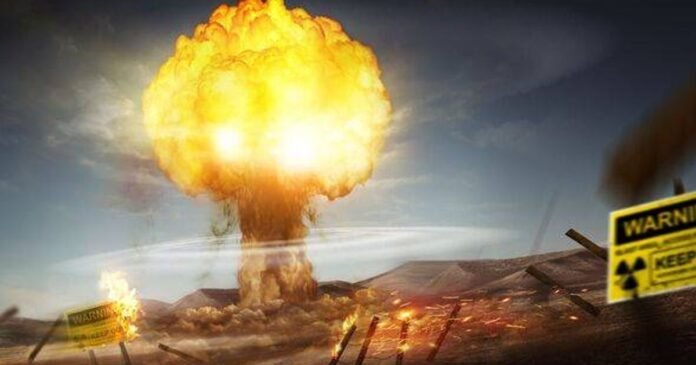
Britain is facing growing worries about its susceptibility to nuclear attacks as tensions escalate worldwide. RAF Lakenheath in Suffolk, under United States management, is set to accommodate US/NATO nuclear weapons soon, positioning the UK at the forefront of potential conflicts involving the US and Russia.
The presence of American nuclear arms on British territory significantly heightens the country’s risk of becoming a target. Military experts indicate that in a wartime scenario, Lakenheath would likely be targeted first before other regions in the country.
Although analysts acknowledge the catastrophic global impact of a nuclear conflict involving the US, NATO, and Russia, it is crucial to understand the direct repercussions for British towns and cities. The Campaign for Nuclear Disarmament alerts that a single nuclear strike on any urban area would be devastating for the local populace and environment, with far-reaching radioactive effects.
Their report highlights that if a Russian missile, such as an SS-25 or SS-27, were to hit central London, nearly a million individuals would perish. Similarly, an attack on Glasgow could result in 326,000 casualties, while Cardiff might see 196,000 lives lost.
The core of a nuclear blast is estimated to reach temperatures in the millions of degrees Celsius. Consequently, a heat flash would incinerate all human tissue within a 1.5 square mile radius.
In a scenario reminiscent of the 1945 atomic bombings of Hiroshima, structures up to four miles from the blast site would be destroyed by the explosion and ensuing firestorm. The report indicates that the immediate fatality rate in the vicinity of the blast would surpass 90%.
Beyond the immediate impact zone, fatalities would gradually rise among survivors of the initial explosion. Emergency services would be overwhelmed, with casualties extending up to 11 miles away, from shattered windows and structural damage.
In the aftermath, survivors would face radioactive fallout, leading to a range of health issues from hair loss to internal bleeding. Long-term effects could include radiation-induced cancers emerging years after the incident.
The environmental and climatic repercussions of a nuclear war could lead to global starvation affecting billions of people. The use of nuclear weapons not only poses a severe threat to public health but also has devastating consequences for the environment and food production systems.

