
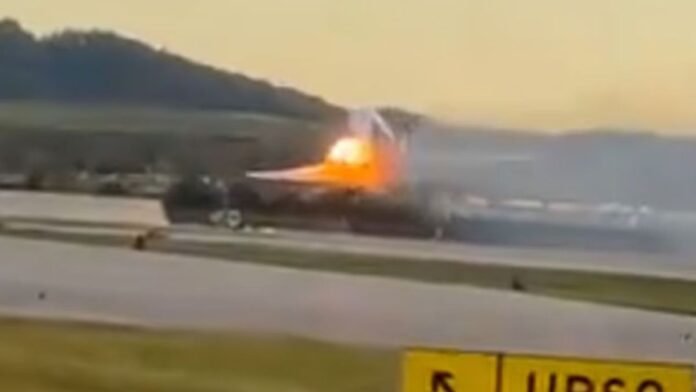
Newly released footage captures the terrifying moment when a UPS plane’s wing caught fire shortly before the aircraft crashed and exploded in a catastrophic fireball. The UPS plane, carrying 38,000 gallons of fuel, erupted into flames just after departing from Louisville Muhammad Ali International Airport in Kentucky at 5:15 pm local time. Tragically, nine individuals lost their lives in the crash, including four who were not passengers. Additionally, eleven people sustained injuries, with two in critical condition.
In a dramatic video taken during take-off, the plane’s left wing can be seen emitting smoke before crashing to the ground moments later, engulfing the area in flames. Pablo Rojas, an aviation attorney, noted that the footage indicated the plane was struggling to gain altitude with a fire on its left side near one of its engines. Due to the substantial fuel load, an explosion or rapid fire growth was inevitable once the fire started in that area.
Mary Schiavo, a former Department of Transportation inspector general, observed that the engine appeared to detach from the aircraft before the final impact and ensuing fireball. An investigation by the US Federal Aviation Administration (FAA) and National Transportation Safety Board (NTSB) is currently in progress to determine the crash’s cause involving a McDonnell Douglas MD-11F aircraft.
Following the crash, a fuel recycling business adjacent to the airport sustained direct impact from the plane, while a car parts business was also affected by the wreckage. Firefighters worked through the night to contain the fire across a significant area and initiated a thorough search for potential victims. The airport remained closed the next day, with no immediate plans to reopen.
Louisville Police Chief Paul Humphrey expressed uncertainty about the timeline to secure the crash site, emphasizing the complexity of the task. Fire chief Brian O’Neill confirmed that the plane triggered secondary explosions upon striking fuel tanks at the recycling center, which included propane and oil storage facilities. O’Neill detailed the presence of small tanks that ruptured, causing the reported secondary explosions.

