
Tiff Macklem, the Governor of the Bank of Canada, indicated that the threat of inflation is increasing, primarily due to rising energy prices, which are now surpassing Canada’s impending dollar-for-dollar tariffs on U.S. products as the main potential cause of higher costs for consumers and businesses.
His comments on Wednesday followed the central bank’s decision to maintain its key interest rate at 2.25 percent, a move that economists widely anticipated. The bank had previously reduced its policy rate to this level in October of the previous year. This announcement marks the seventh consecutive time the bank has opted to keep its benchmark rate unchanged.
Macklem stated to reporters in Ottawa, “The counter-tariffs, along with the U.S. tariffs, will impose additional costs on certain businesses. While these tariffs are quite high, they are applied to a relatively limited range of goods.”
He noted that a more pressing issue is the ongoing conflict in the Middle East.
“The conflict has intensified, and oil prices are rising again,” Macklem remarked. “The longer this situation persists, the greater the risk that it will affect the prices of other goods and services.”
In its announcement, the bank acknowledged that recent data supports its forecast of a “broadening recovery” in the economy. However, it also cautioned that the war and U.S. tariffs heighten the risk of inflationary pressures.
Since the bank’s last announcement in July, U.S. benchmark oil prices have surged approximately 13 percent. The U.S.-led military actions in Iran have escalated recently, leading to a slowdown in tanker traffic through the Strait of Hormuz, a vital route for oil to reach international markets.
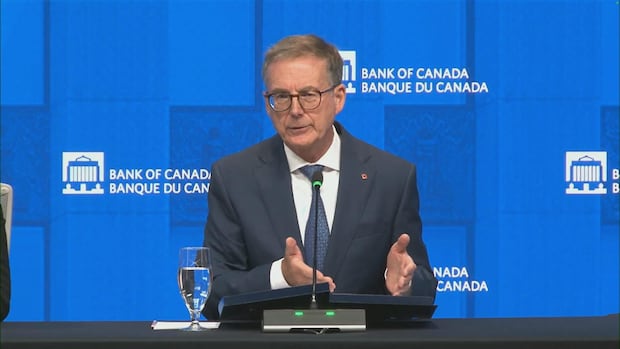
According to Bank of Canada governor Tiff Macklem, while the central bank will revise its estimates, officials currently assess that the ‘inflationary impact of those counter-tariffs is fairly modest,’ emphasizing that the situation in the Middle East is the ‘more significant issue’ for inflation.
Concurrently, tensions in the Canada-U.S. trade relationship have greatly intensified since the bank’s last meeting in July.
Last month, U.S. President Donald Trump instituted 50 percent tariffs on approximately $28 billion worth of Canadian goods. Beginning Tuesday, Canada will reciprocate with dollar-for-dollar tariffs on $27.6 billion of equivalent U.S. products.
Recently, the federal government announced a $7.5-billion expanded economic relief initiative for affected workers and businesses. This new support is in addition to the nearly $25 billion in tariff assistance provided over the past 18 months.
Macklem: Inflation is ‘too high’
Canada’s inflation rate climbed to three percent in July as tensions in the Middle East impacted prices at Canadian gas stations.
“That’s excessive,” Macklem remarked, highlighting the bank’s goal of achieving an inflation rate of two percent. “The increase is primarily linked to gasoline and oil prices, which are directly influenced by the conflict in Iran.”
Derek Holt, Scotiabank’s vice president and head of capital markets economics, believes Macklem has placed significant importance on the upcoming economic forecasts set to be released in October.
“There will be a lot more data to analyze between now and October 28, including details on inflation, employment, GDP, alongside developments in the energy market and trade, but the Bank of Canada has clearly opened the door to the possibility of tightening rates as soon as the next meeting if conditions allow,” Holt stated in a research report.
He anticipates rate hikes of 75 basis points starting in the final quarter of 2026.
Trade uncertainties persist
Avery Shenfeld, chief economist at CIBC, noted that the decision to hold rates steady was expected “given the uncertainty surrounding the trade war.”
“The escalating uncertainty in trade relations complicates the outlook to such an extent that it is difficult to predict what the future holds,” Shenfeld commented in a note released after the decision.
“The bank assessed that the immediate effect of the latest round of tariffs would not be substantial, but acknowledged that trade uncertainties could further dampen growth,” he added.
“It did not address the negative implications of failing to reduce existing tariffs on automobiles, metals, and lumber, which most economic forecasts had assumed would occur.”
Shenfeld foresees little chance of a rate adjustment in either direction throughout 2026, pointing out that both the oil and trade war situations could change dramatically in the coming months.
The bond market’s situation
While the Bank of Canada directly influences short-term borrowing costs, longer-term rates are determined by the bond market. In the U.S., treasury yields have surged to multi-year peaks as investors seek higher returns, partly due to expectations that the U.S. Federal Reserve will increase its short-term benchmark rate.
“We are observing some spillover of global bond yields into Canada,” Macklem mentioned on Wednesday, adding that Canada’s yield curve remains significantly below that of U.S. treasuries.
“It’s crucial to differentiate between volatility and instability when yields and prices fluctuate, as investors are reevaluating risk,” Carolyn Rogers, Senior Deputy Governor of the Bank of Canada, explained to reporters.
“The vulnerabilities we have discussed in previous financial stability reports arise when leveraged investors quickly unwind their positions, leading to a drying up of liquidity,” she continued. “That is the risk we are concerned about, but we do not see it occurring at this moment.”
The yield on the 10-year Government of Canada bond rose above basis points to 3.80 percent on Wednesday, marking its highest level in over two years.
A Reuters survey conducted on August 22 revealed that all 35 economists predicted that policymakers would maintain the bank’s key rate during Wednesday’s meeting. The next rate announcement from the Bank of Canada is set for October 28.

