
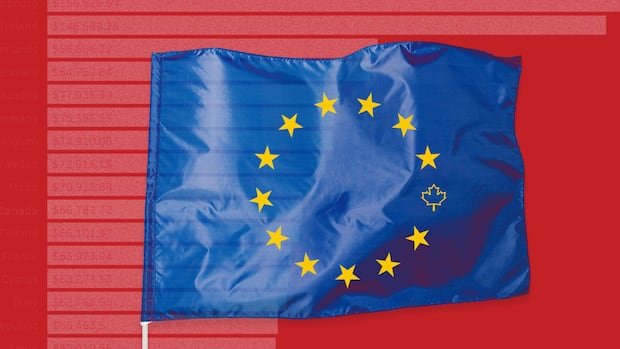
The European Union is eyeing Canada to potentially become its first “associate member” among the 27-nation bloc, amid global efforts to expand trade partnerships beyond the United States. European Commission President Ursula von der Leyen emphasized the need for a reimagined partnership between the EU and Canada, moving beyond a mere free-trade agreement.
Canadian Prime Minister Mark Carney expressed support for closer ties in his address, emphasizing Canada’s pursuit of resilience and sovereignty. He outlined plans to enhance integration across critical sectors such as critical minerals, artificial intelligence, defense, energy, research, and finance, highlighting the importance of sovereignty and the ability to withstand challenges.
Although the term “associate member” is not officially recognized in EU regulations, Canada is poised to strengthen its trade relations with Europe. Comparisons reveal that Canada’s GDP per capita positions it favorably among EU nations, surpassing countries like France, Italy, and Spain. Despite not being an EU member, Canada’s economic performance aligns with many EU states, although some non-bloc nations like Australia and Iceland outperform Canada in certain metrics.
In terms of inflation, Canada’s two percent rate in 2025 outperforms many EU countries, showcasing resilience amid global economic challenges. However, Canada’s total debt-to-GDP ratio is a concern, potentially ranking among the highest in the EU if Canada were a member. The International Monetary Fund has raised this issue, urging Canada to prioritize reducing its debt ratio for sustainable fiscal planning.
Analyzing trade relationships, Canada imported around $92 billion and exported approximately $39 billion worth of goods to the EU in the previous year. Germany plays a central role in Canada’s European trade, with imports including machinery and vehicles, while exports comprise energy products and precious metals.
Overall, the EU’s proposal for Canada as an “associate member” signals a potential shift in trade dynamics, with opportunities and challenges ahead for strengthening bilateral ties between the two partners.

