
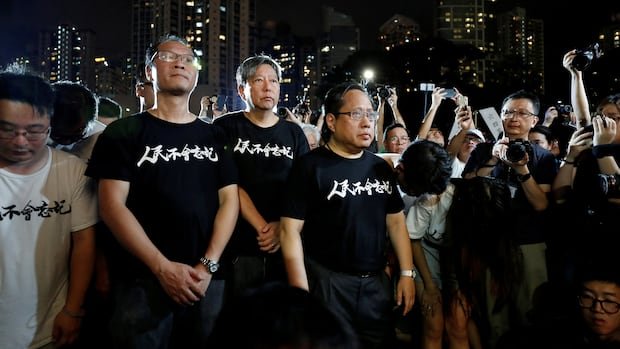
Three activists in Hong Kong, known for organizing vigils in memory of the Tiananmen Square crackdown in 1989, were sentenced to prison terms ranging from five to over seven years by a Hong Kong court on Friday. The case is viewed as a measure of the city’s freedoms amidst Beijing’s crackdown on dissent. Lee Cheuk-yan, Chow Hang-tung, and Albert Ho were found guilty of inciting subversion earlier this year under a national security law imposed by Beijing. Lee and Chow, who pleaded not guilty, received seven years and seven years plus three months in prison, respectively, while Ho was given five years plus two months, a lighter sentence due to his guilty plea.
The trio was charged in September 2021 and has been in custody for years. Hong Kong once had a vibrant civil society with massive protests and a robust press scene. For thirty years, the vigil they organized was the only significant public commemoration in China, drawing tens of thousands annually, symbolizing the civil liberties enjoyed in Hong Kong under the “one country, two systems” principle. However, following a protest movement in 2019, public choice in elections was limited, and leaders of critical news outlets were prosecuted. Numerous activists were imprisoned under the security law, leading to the dissolution of many civil society groups, including the alliance.
The latest high-profile penalties under the security law include the sentencing of former pro-democracy media tycoon Jimmy Lai to 20 years in prison earlier this year. Following the recent sentencing, Lee’s wife Elizabeth Tang stated that Lee would appeal the verdict, highlighting the lack of freedom of speech in Hong Kong and the shock felt by many at the sentences. Chow’s mother, Medina Chow Lau Wah-chun, expressed gratitude to the prosecutors for documenting the truth about the 1989 crackdown and recent events in Hong Kong in court records. Chow’s friend, Lau Ka-yee, confirmed that Chow would also appeal.
The court, with three government-approved judges, deemed the defendants’ offense as serious, citing their organization’s call to “end one-party dictatorship” as implying an intent to undermine the Communist Party’s leadership. The judges acknowledged the absence of violence or threats in the case but emphasized the turbulent social atmosphere at the time, posing a risk to national security. They maintained that the trial was not based on the defendants’ political views but on their actions following the enactment of the national security law.

