
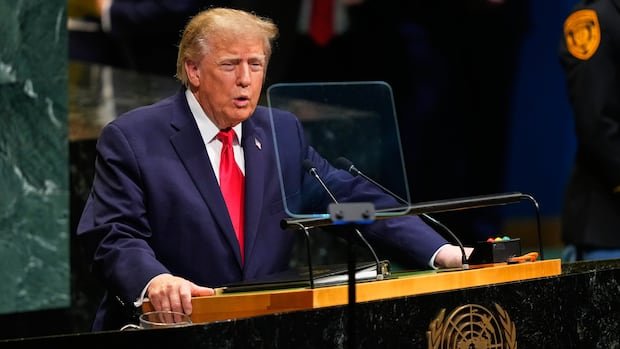
U.S. President Donald Trump emphasized his commitment to utilizing military force to safeguard his nation’s interests and prevent what he perceives as “hostile foreign adversaries” from expanding their influence in the Western Hemisphere. In his address to the United Nations General Assembly, Trump issued a stern warning to Iran, asserted claims to Venezuela’s oil reserves, and defended U.S. actions against alleged drug traffickers in the Caribbean. He indicated the possibility of further interventions in the future, highlighting the decisive actions taken by the U.S. to address longstanding global issues.
Trump underscored the proactive use of American military power both domestically and internationally to foster a secure future for all. While his speech briefly touched on Russia’s conflict with Ukraine, he made no new proposals for resolving the ongoing strife. The President’s address predominantly focused on the Western Hemisphere, aligning with the national security strategy released last December, which received accolades from the Kremlin for advocating the revival of the Monroe Doctrine, asserting U.S. dominance in the region.
Citing past administrations’ failure to address challenges in the region, Trump vowed to combat criminal elements such as gangs and drug cartels and prevent hostile foreign entities from subverting American interests in the Western Hemisphere. He specifically highlighted the U.S.’s actions in Venezuela as a demonstration of its commitment to safeguarding vital national interests, claiming control over Venezuela’s oil resources as a strategic victory.
Trump’s speech outlined his vision of asserting U.S. control, if not dominance, in the Western Hemisphere, according to Shannon O’Neil, a senior vice-president at the Council on Foreign Relations. The President’s remarks did not mention Canada, indicating a focus on broader geopolitical concerns over trade disputes and border security. Trump singled out Mexico as a hub of drug cartel violence and expressed intentions to push for significant changes in Cuba.
Addressing the Iranian situation, Trump posed a critical decision of whether to pursue a deal with Iran or pursue a more aggressive stance, emphasizing the potential consequences of each choice. Mara Rudman, a former U.S. deputy special envoy for the Middle East, characterized Trump’s approach as tactless but suggested that external pressures, such as the upcoming U.S. midterm elections, may influence his decision-making on Iran.
In his speech, Trump also dismissed concerns about artificial intelligence risks, reiterated his criticisms of the United Nations and labeled the International Criminal Court as a renegade institution. These statements underscored his administration’s assertive stance on various global issues, signaling a proactive and robust foreign policy agenda.

