
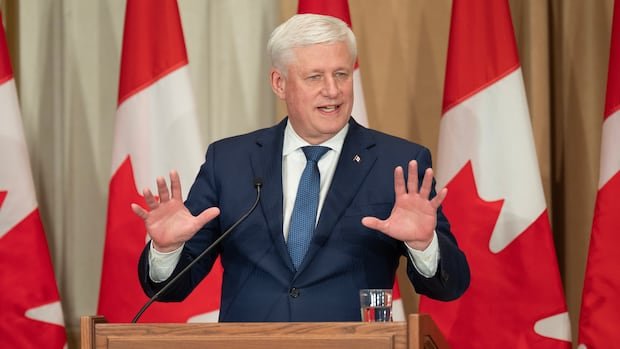
Former Canadian Prime Minister Stephen Harper expressed concerns about the possibility of Alberta separating from Canada in an article published on Friday. Harper emphasized that voting for separation, even as a symbolic gesture, would entail significant risks and challenges. He highlighted the absence of credible leadership to establish a new independent country.
On October 19, Albertans will decide in a referendum whether the province should remain part of Canada or pursue a path towards separation. Harper, whose official prime ministerial portrait was recently unveiled, called for unity between Liberals and Conservatives amidst growing separatist sentiments in Alberta and Quebec.
In a separate event, Harper supported the federal government’s decision to discontinue trade talks with the United States at the Canada Investment Summit. He emphasized the need for Canada to reduce its reliance on the US to safeguard its sovereignty.
Current Conservative Leader Pierre Poilievre echoed Harper’s stance on maintaining a united Canada. Poilievre criticized the Liberal government for fueling discontent but argued that separation would not address provincial grievances effectively.
Despite some Albertans feeling marginalized by Ottawa, Harper cautioned against pursuing independence, advocating instead for immediate action to address existing barriers to long-term stability and prosperity in Canada. Polls consistently show that a majority of Albertans prefer to remain part of Canada, although separatist leaders are actively campaigning to sway public opinion.
Proponents of Alberta independence argue that voting for a future binding referendum would provide leverage in negotiations with Ottawa. They believe that such a move would strengthen Alberta’s position in determining its future. However, Harper disagreed with this strategy, cautioning that prolonging the separatist debate without clear objectives could be counterproductive.
The debate surrounding Alberta’s potential separation has gained momentum, with various leaders and groups expressing conflicting views. While Harper’s federalist stance is well-known, recent developments, including discussions around the West Coast oil pipeline, have added complexity to the ongoing discourse.
Harper asserted that his government successfully addressed separatist sentiments during his tenure, particularly in relation to energy policies. Poilievre also claimed that separatism was eradicated under Harper’s leadership, a statement that faced criticism from the Bloc Québécois.
As the referendum date approaches, the conversation around Alberta’s future within Canada continues to evolve. Harper’s perspective, along with the diverse opinions within the political landscape, underscores the complexity and significance of the upcoming decision for Alberta and the country as a whole.

