
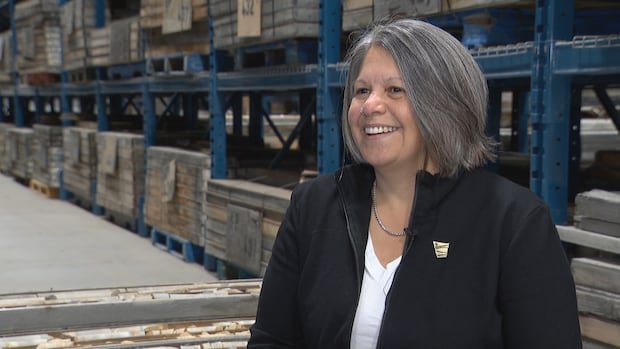
The Northwest Territories has become the pioneer in Canada by offering drill core samples to a state-of-the-art digital library designed to enhance public access to the mineral data contained in these samples.
Drill cores are elongated rock cylinders obtained by miners and prospectors to confirm mineral deposits. These cores are usually stored in boxes by mining and exploration companies on their premises or in various locations across Canada, making it challenging for industry experts, researchers, and the public to analyze them.
The Canadian Digital Core Library, supported by $40 million in funding from Natural Resources Canada, aims to address this issue. This initiative will enable a broad range of samples to be accessible online for free, facilitating more advanced analysis using artificial intelligence (AI) technology.
The development of this platform is a collaborative effort involving Creative Destruction Lab, along with provinces, territories, industry partners, and academia. The core samples will undergo a variety of scans to provide high-resolution images and comprehensive data beyond what a simple photograph can offer.
Scanning of the samples commenced in Calgary in September, with Creative Destruction Lab projecting that at least 250,000 meters of scanned drill core will be uploaded to the library by March 2028.
Kumari Karunaratne, the director of the Northwest Territories Geological Survey, emphasized the significance of the digital core library in enhancing exploration efficiency and promoting sustainable development of the region’s abundant mineral resources.
She highlighted the importance of avoiding redundant drilling activities by utilizing the existing information preserved in the drill cores. These cores also provide valuable insights into the geological characteristics of the rocks where they were extracted.
Tyler Acorn, a data geoscientist at the N.W.T. Geological Survey, explained the advantages of the technology used to digitize a vast array of core samples. Instead of the traditional and costly process of sending samples to assay labs, digital scanning provides detailed information throughout the entire drill hole, enhancing the depth and breadth of available data.
The extensive dataset generated from the core samples will enable AI models to identify patterns indicative of geological features that may not be immediately evident. Stakeholders from the industry, such as Rackla Metals, view the Canadian Digital Core Library as a valuable resource for mineral exploration and resource extraction nationwide.
The company’s vice president of exploration, Scott Casselman, emphasized the library’s utility in identifying new exploration targets and comparing project data to uncover potential elements that may have been overlooked.
Encouraging other companies with projects in Canada to follow suit, Rackla Metals’ operations manager, Michael Shultz, advocates for the digitization and inclusion of core samples in the library for the benefit of the broader industry.

