
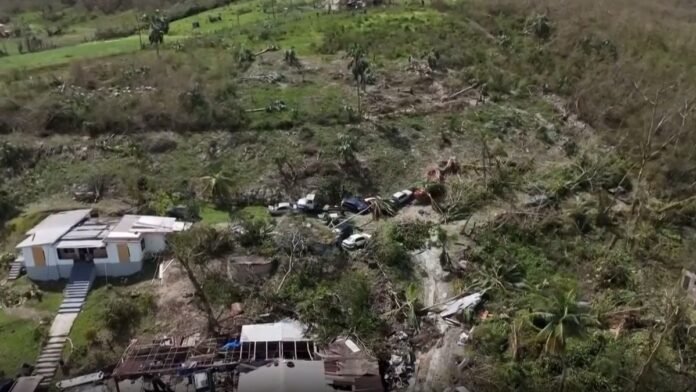
Video footage reveals extensive damage with buildings’ roofs and walls collapsed, trees downed, and roads obstructed following the impact of Hurricane Melissa.
In the journey towards Black River, a town located two hours south of Kingston, Jamaica, debris blocked roads, preventing cars from passing through and isolating the community. Videos depicted a line of vehicles stranded on a road obstructed by fallen trees, alongside images showing destroyed houses in ruins.
Hurricane Melissa has resulted in numerous fatalities and extensive destruction across Cuba, Haiti, and Jamaica. In Jamaica’s St. Elizabeth parish, a landslide blocked the main streets of Santa Cruz, turning them into muddy pits.
Residents were seen removing water from their homes as they attempted to salvage their belongings. The strong winds tore off parts of the roof at a public shelter located in a high school. Resident Jennifer Small expressed astonishment, stating, “I have never witnessed anything like this before in all my years here.”
The full scope of the devastation caused by the Category 5 hurricane remains uncertain due to widespread power outages and hazardous conditions that persist. Jamaica’s education minister, Dana Morris Dixon, mentioned, “It is too early for us to provide a definitive assessment.”
Melissa made landfall in Jamaica on Tuesday with peak winds of 185mph, making it one of the most intense Atlantic hurricanes on record. After weakening, the storm moved on to Cuba, affecting even countries outside its direct path.
According to Haiti’s Civil Protection Agency, at least 23 individuals have lost their lives in Haiti, with 13 individuals reported missing. The town of Petit-Goâve experienced significant flooding that led to the collapse of numerous homes. The death toll in Haiti is subject to change in the initial phase following major natural disasters.
In Cuba, officials documented collapsed houses, blocked mountain roads, and roofs torn off buildings, predominantly in the southwest and northwest regions. Approximately 735,000 people sought refuge in shelters across the affected areas. A resident in Santiago de Cuba described the experience as “hell” and highlighted the severe impact of the storm.
In Jamaica, over 25,000 individuals sought shelter after their homes were damaged by the storm, leaving them temporarily displaced. The island faced widespread power outages, hampering damage assessment efforts due to communication disruptions in various areas.
Prime Minister Andrew Holness assured that the government is fully engaged in the recovery process, preparing relief supplies and striving to restore normalcy swiftly.
In the coastal town of Black River, which is home to around 5,000 residents, officials urgently requested assistance during a press briefing. Mayor Richard Solomon described the situation as catastrophic based on their observations.
Solomon mentioned that the local rescue infrastructure was severely damaged by the storm, rendering essential services like hospitals, police units, and emergency response teams incapable of carrying out their duties. The storm also destroyed the storage facility for relief supplies.
<p class

