
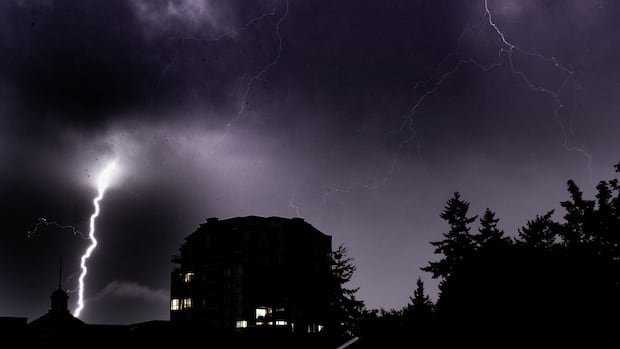
Lightning strikes illuminated the skies over British Columbia’s South Coast overnight during a rare thunderstorm, causing disruptions at Vancouver International Airport and impacting flight schedules in the process. CBC meteorologist Johanna Wagstaffe described the storm as a significant system with numerous cloud-to-ground lightning strikes, particularly in the Vancouver/Richmond area.
The intense weather event was attributed to a low-pressure system moving onshore near Richmond, carrying a high moisture content after traveling from the equator. Environment Canada reported over 1,800 instances of lightning in the Lower Mainland on Saturday night and Sunday morning, with the B.C. Wildfire Service recording more than 7,000 lightning strikes province-wide.
The storm led to power outages with more than 3,800 customers affected in the Lower Mainland and Sunshine Coast regions by Sunday morning. At Vancouver International Airport, the thunderstorm caused multiple delays and cancellations between 9 p.m. Saturday and 3 a.m. PT on Sunday, leaving passengers like Simone McCallum stranded overnight at the terminal.
YVR spokesperson Stephen Smart apologized for the inconvenience caused and mentioned that the storm lasted over five hours, dumping 64 millimeters of rain on the airport. The airport faced operational challenges, with flooding reported in some areas and disruptions continuing into Sunday, affecting flight schedules.
The B.C. Wildfire Service reported about 2,000 lightning strikes in the Coastal Fire Centre and 5,000 in the B.C. Interior, leading to 48 wildfires within 72 hours. Crews were on high alert, with pre-positioned resources for an efficient response. The storm brought substantial precipitation, aiding firefighting efforts but not fully alleviating the impact of months-long drought conditions.
Environment Canada issued severe thunderstorm watches for southeast B.C., while a high streamflow advisory was issued for various regions, including the Central Interior. Significant rainfall was recorded across southern B.C., with areas like Horseshoe Bay seeing 43.4 millimeters of rain. The Coquihalla Summit, North Cowichan, Merritt, and Lillooet also experienced substantial rainfall.
As the storm moved eastward, forecasts warned of potential road closures due to heavy rains, urging travelers to stay updated on road conditions. The unique thunderstorm activity in Metro Vancouver surprised residents, highlighting the region’s infrequent encounters with such weather phenomena.

