
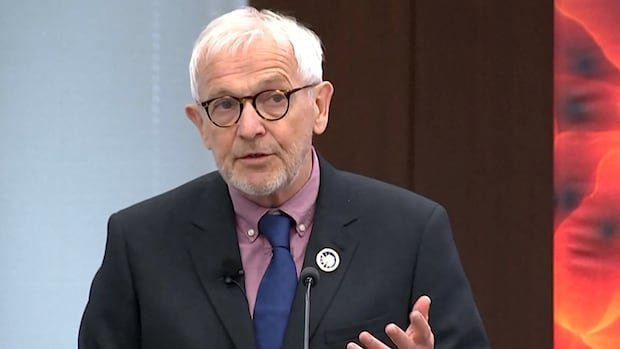
Belgian-American physicist Francis Halzen, aged 82, was named the recipient of the 2026 Nobel Prize in Physics on Tuesday in Stockholm. Halzen was acknowledged for his significant contributions to the IceCube Neutrino Observatory and the identification of high-energy neutrinos originating from space, as stated by the awarding organization. Situated at the Amundsen–Scott South Pole Station in Antarctica, the observatory was a realization of Halzen’s insight on utilizing South Pole ice to track neutrinos, often referred to as “ghost particles” due to their ability to traverse the Earth and human bodies without leaving a trace, interacting with matter very infrequently.
During a news conference, Eva Olsson from the Royal Swedish Academy of Sciences mentioned, “The messengers bring information from the cosmos,” elucidating how neutrinos enable the understanding of distant galaxies and the phenomena of exploding stars. Winners of the Nobel Prize in Physics are chosen annually by the Royal Swedish Academy of Sciences and receive an award totaling 12 million Swedish crowns ($1.7 million Cdn).
The IceCube, covering a cubic kilometer, became operational in 2011, marking the realization of a concept for the South Pole observatory that originated in the late 1980s. Halzen, who has been associated with the University of Wisconsin–Madison in the U.S. for many years, expressed his delight and surprise at the announcement while attending a conference in Italy. In 2014, he was dubbed “Neutrino Man” by the U.S.-based Smithsonian magazine when presented with one of its Ingenuity Awards.
Neutrinos, minuscule cosmic particles with an incredibly small mass, are omnipresent and emanate from celestial bodies like the sun, with trillions passing through human bodies each second. Scientists cannot directly observe these enigmatic particles but infer their presence through interactions generating light flashes or charged particles upon collision with matter.
Halzen’s research focused on a unique group of neutrinos considered cosmic messengers, providing insights into the evolution of the universe. Mark Pearce, chair of the Nobel Committee for Physics, praised Halzen for leading an international team that developed a groundbreaking instrument, fostering a new realm of astronomy through perseverance and scientific foresight.
Plans for an extension, IceCube-Gen2, covering eight cubic kilometers of ice and slated for operation in 2033, aim to enhance neutrino detection capabilities, including weaker signals. Halzen emphasized that the true impact of his work is yet to unfold, underscoring the introduction to a new era of science and astronomy.
Belgian Prime Minister Bart De Wever extended congratulations to Halzen for his dedication to unraveling cosmic mysteries through the study of the universe’s subtle manifestations. The Swedish academy acknowledged the discovery of neutrino oscillations in 2015, with Canadian scientist Dr. Arthur McDonald sharing the Nobel physics prize that year.
The Nobel Prize in Chemistry will be revealed on Wednesday, the literature prize on Thursday, and the peace prize on Friday, with the economics prize announcement scheduled for October 12. Established by Alfred Nobel, a Swedish chemist and entrepreneur, the Nobel prizes honor individuals who have made significant contributions benefiting humanity. Nobel’s legacy includes his invention of dynamite, his multilingual abilities, and his passion for poetry and drama, evident in the five original prize categories aligned with his interests. The laureates will receive their Nobel prizes on December 10, commemorating Nobel’s passing.

