
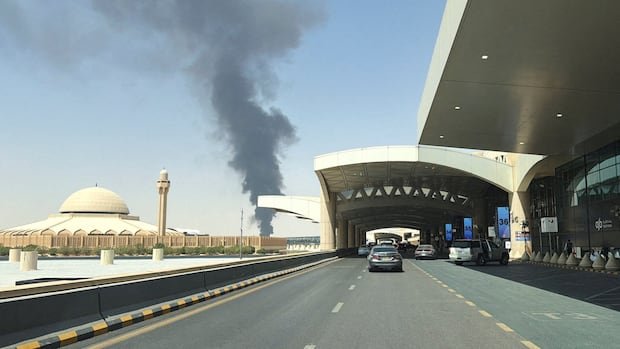
An airline pilot was one of three Saudi nationals who lost their lives in assaults aimed at Riyadh’s King Khalid International Airport, as per the Saudi Civil Aviation Authority’s announcement on Friday. The initial strike on the airport’s facilities occurred on Thursday, followed by an attack on a Saudi aircraft, the statement revealed. The responsible parties were not disclosed, although the Houthis claimed responsibility for targeting the airport with a ballistic missile. The kingdom reported that numerous individuals of various nationalities sustained injuries in the attacks.
Capt. Hamoud Ali Alkalthami was one of the deceased, as confirmed by the Saudia Group in a released statement. This incident seemed to mark the first verifiable attack on the Saudi national carrier since the recent offensive began. Another statement from the Saudia Group mentioned that one of their aircraft suffered damage while stationed on the ground without passengers. According to the aviation statement, the injuries ranged from minor to severe for citizens and individuals of other nationalities. The Saudia Group later stated that operational activities at the airport had returned to normal.
On Thursday, numerous flights to and from Riyadh were canceled, as reported by flight-tracking site FlightAware. The Indian Embassy stated that Air India had suspended operations until Saturday, while the Lufthansa Group announced the suspension of flights to Riyadh until October 16. Pakistan International Airlines also halted flights to Riyadh due to the evolving situation in the Middle East, as confirmed by an airline spokesperson. The U.S. Embassy had previously cautioned citizens about potential airspace closures.
The assaults on Thursday marked the deadliest incidents in Saudi Arabia since the kingdom and allied forces launched a major military offensive against Yemen’s Iran-backed Houthi rebels over the weekend. These attacks represented a significant escalation in the ongoing Iran conflict, which has led to fluctuations in oil prices and financial markets.
The Saudi-led coalition combating the Houthis stated that they had eliminated three rocket launch platforms used by the rebels to endanger regional security. The Saudi capital’s airport has faced multiple attacks in recent days. The Houthis had warned global airlines about the potential consequences of operating in Saudi airspace, which they described as a battleground for their military operations.
Earlier in the week, Saudi officials reported that attacks claimed by the Houthis on airports in Riyadh and Abha resulted in the deaths of three individuals. The kingdom has sought backing from allies, including the United States, with U.S. support encompassing intelligence sharing, target identification, and planning for the recent offensive. Despite this, President Donald Trump has shown reluctance to increase U.S. military engagement in the Middle East and has not directed American forces to resume strikes against the rebels at this time.
The offensive’s objective is to recapture territory seized by the Houthis a month ago along Yemen’s western Red Sea coast and the strategic Bab el-Mandeb Strait. Their presence in that region poses a threat to an essential alternative shipping route to the Strait of Hormuz, where Iranian assaults on vessels have disrupted maritime traffic. The prolonged conflict, essentially a proxy war between Saudi Arabia and Iran, has resulted in widespread suffering and deprivation in Yemen, the poorest nation in the Arab world.
In 2014, Houthi rebels descended from their stronghold in the north and captured the capital, Sanaa. In 2015, a Saudi-led coalition intervened on behalf of Yemen’s internationally recognized government, with the United Arab Emirates initiating a reduction of its military involvement in the coalition in 2019. The war has claimed over 150,000 lives, including combatants and civilians, and triggered one of the most severe humanitarian crises globally. A ceasefire agreed upon in 2022 was largely observed until the recent escalation.

