
Kaveeshan Thurairajah, a PhD student at the University of Waterloo, may not have earned a Nobel Prize, but he is a recipient of an Ig Nobel Prize.
The Ig Nobels are a humorous take on the Nobel Prizes, recognizing the most eccentric and creative research in academia.
This year, Thurairajah and his team received the Ig Nobel Physics Prize for their innovative work on a splash-free urinal design.
He vividly recalls when his supervisor, fluid physicist Zhao Pan, delivered the exciting news.
“[He asked], ‘Hypothetically, would you be pleased, offended, or indifferent if you won the Ig Nobels?’ I responded, ‘Oh yes, I would be thrilled,'” Thurairajah shared with As It Happens host Nil Köksal.
“And then he said, ‘Great, because we did win.’ He then produced a bottle of wine from his office cupboard, and we celebrated with espresso cups.”
‘Anatomically accurate pee machine’
The team of award-winning scientists developed and evaluated multiple urinal prototypes in their search for the ultimate splash-free model, which included the sleek and slender Nautilus (pronounced naughty-LOO) and the tall, angular Cornocopia (pronounced corno-co-PEE-ah).
“The Nautilus stands out as the best option because it effectively minimizes splashing and is much easier to clean compared to the Cornucopia design,” Thurairajah explained.
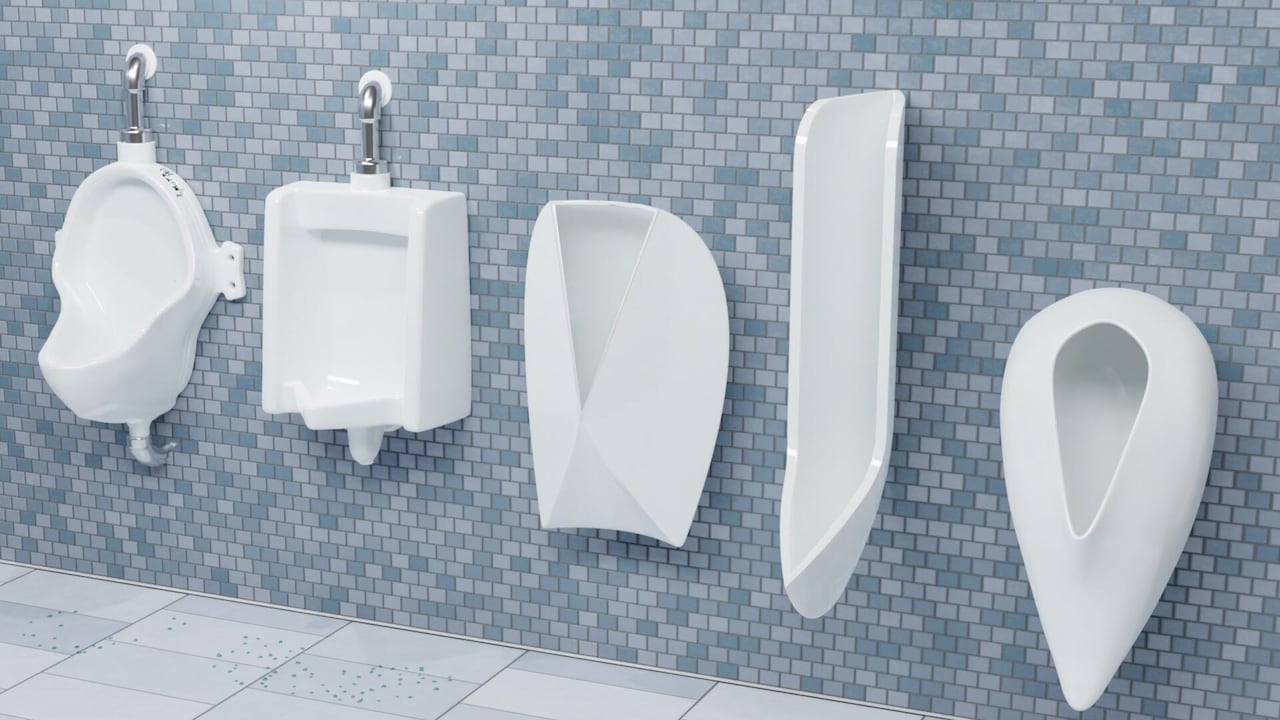
The researchers evaluated various urinal prototypes, such as the Cornucopia, in the center, and the Nautilus, second from the right. (Zhao Pan/University of Waterloo)
Thurairajah and his colleagues arrived at the awards ceremony in Zurich on Thursday dressed in vibrant yellow raincoats, prepared to receive accolades from their fellow quirky scientists.
However, he emphasized that no one was splashed with actual urine during their experiments.
“Testing it ourselves would be unhygienic and, more importantly, unscientific. My urination rate wouldn’t be consistent, making it hard to compare results,” he stated.
“We began by researching typical flow rates observed in human males and subsequently constructed an anatomically accurate pee machine.”
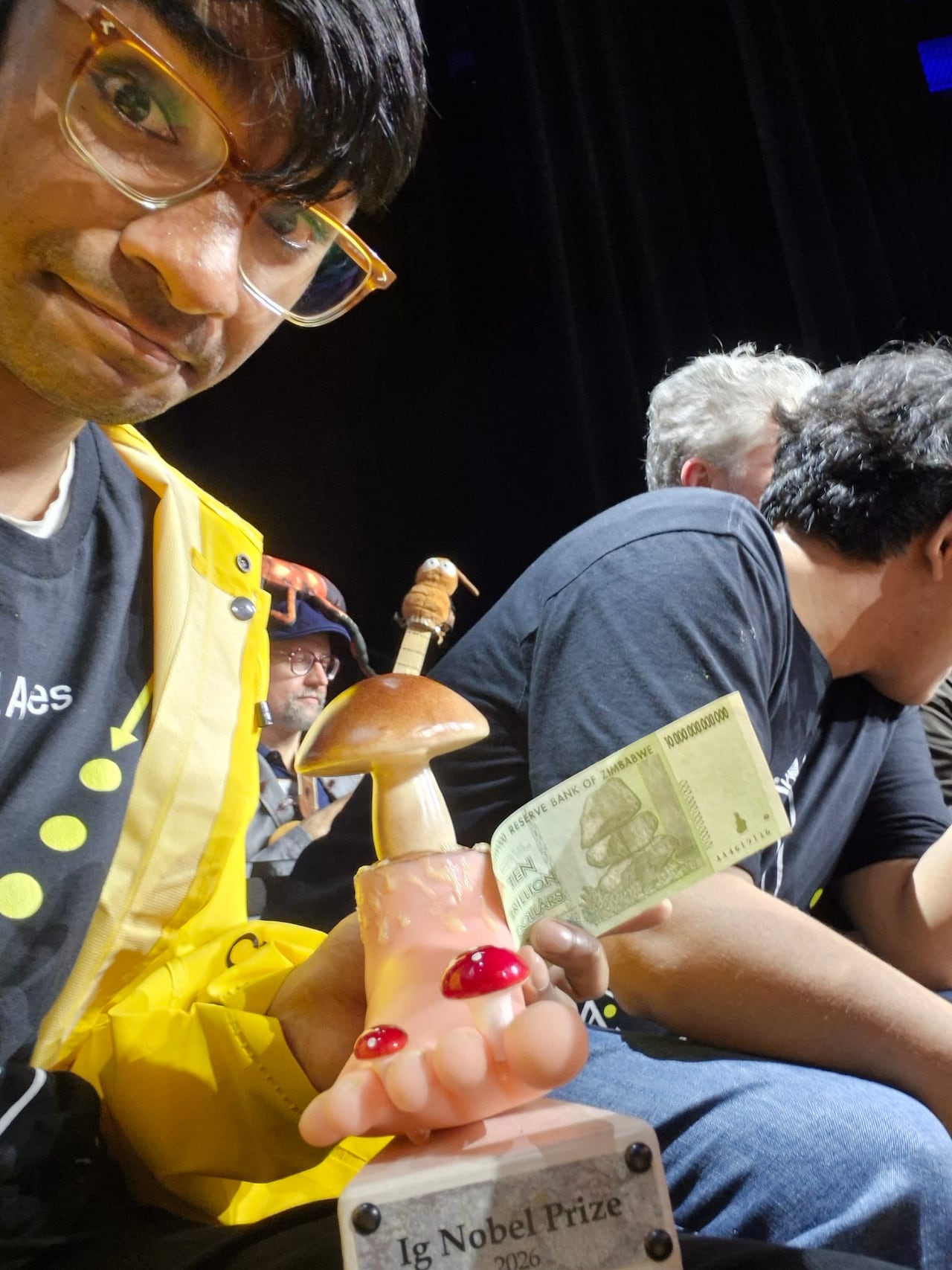
Kaveeshan Thurairajah from the University of Waterloo proudly displays his Ig Nobel prize — an unusual foot-shaped mushroom statue and a ten-trillion dollar bill from Zimbabwe, valued at between $15 and $30 Canadian. (Submitted by Kaveeshan Thurairajah)
While he enjoys the humor in the situation, Thurairajah believes the urinal research holds genuine societal value.
“If we can enhance the appeal of bathrooms and public spaces, it benefits society as a whole,” he remarked.
The research findings were published last year in the journal PNAS Nexus.
Canadians study stealing candy from kids, mosquito nose printers
The physicists from Waterloo were not the only Canadians recognized at the awards ceremony on Thursday.
A research team that included scholars from the University of Toronto was awarded the Economics Prize for their findings that upper-class individuals are more prone to stealing from children’s candy supplies and engaging in other unethical actions.
Scientists from McGill University were part of a team that received the Technology Prize for “innovating the use of mosquito proboscises as high-precision 3D printing nozzles.”
Other researchers were awarded for reconstructing the evolutionary history of kissing, exploring the science behind nose blowing, and burying 1,000 pairs of underwear across more than 25 countries to examine how soil organisms facilitated decomposition.

Attendees launch paper airplanes during the Ig Nobel Prize ceremony at the Zurich Convention Center. (Claudio Thoma/Keystone/The Associated Press)
The Ig Nobel awards, organized by the Annals of Improbable Research, have moved to Europe after 35 years in the United States due to concerns regarding attendees’ visa accessibility.
Thurairajah, whose colleagues in the urinal design project hail from China, the U.S., and Saudi Arabia, believes this decision was appropriate.
“The global scientific community is inherently international, and we all gain from and contribute to one another,” he stated.
“I would dislike being in a situation where fellow award recipients or past winners could not attend. It would feel like a betrayal to them.”

