
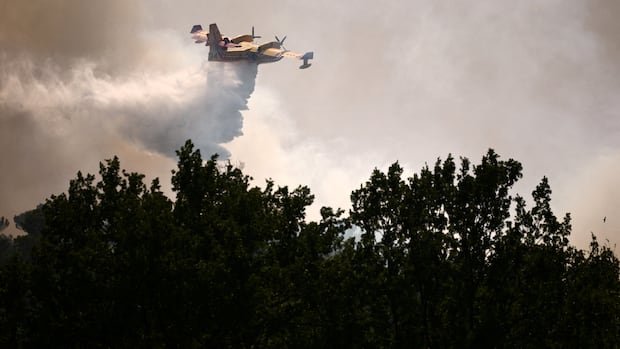
In the midst of France facing its most severe wildfire crisis since World War II, President Emmanuel Macron’s administration received prompt backlash regarding its readiness for the extensive fires. However, attention soon shifted towards Canada, an unexpected focus.
Didou Deyres, the vice-president of the forest fire defense department in Le Porge, where 183 residences were engulfed by flames in late July amid pine forest blazes outside Bordeaux, highlighted the shortage of Canadairs. France possessed 12 of these distinctive yellow water bombers, but at the peak of the crisis, only seven were operational, according to Deyres.
Expressing that additional firefighting resources both on the ground and in the air could have potentially altered the outcome, Deyres humorously attributed blame to Canada. He emphasized the necessity for collaboration with Canada to enhance the aircraft fleet.
The demand for Canadian-made water bombers is escalating across Europe due to droughts and successive heatwaves fueling destructive fires, thereby intensifying the need for governments to expand their aerial firefighting capabilities.
European nations have placed orders for 22 new Canadair 515 planes from De Havilland Canada since 2022. However, the first batch of these aircraft is not anticipated to be delivered to European customers until 2028, with France likely waiting until 2032 for the remaining four from its order.
Acknowledging the critical role these aircraft play in firefighting operations, Neil Sweeney, De Havilland Canada’s vice-president of operations, emphasized the significance of the Canadair fleet. The company is working to meet the increasing demand for these specialized aircraft.
With concerns over the production timeline and capacity, questions arise regarding whether De Havilland should expand production preemptively to cater to potential future orders. While discussions on streamlining production processes and potential partnerships continue, the urgency to address these challenges becomes more apparent as competitor firms in Europe are also striving to develop similar firefighting aircraft.
As Canada’s dominant producer of water-scooping aircraft, De Havilland faces the challenge of maintaining its position in the market amidst growing competition and evolving demands for aerial firefighting resources. The need for proactive measures to enhance production capacity and meet the escalating global demand for these specialized aircraft becomes imperative to sustain Canada’s influence in the industry.
—
The revised article provides a comprehensive overview of the wildfire crisis in France and the growing demand for Canadian-made water bombers in Europe. It emphasizes the need for proactive measures to address production challenges and meet the increasing demand for specialized firefighting aircraft.

