
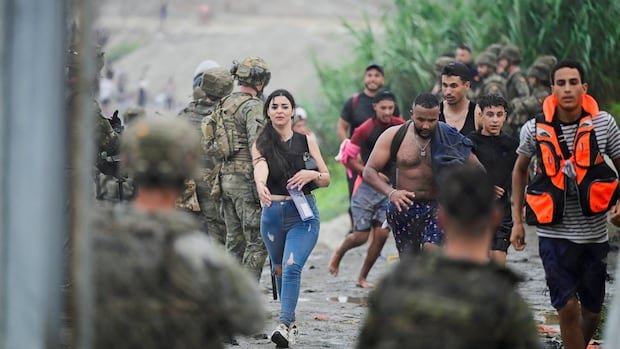
Spain and Morocco have strengthened the border fence of a Spanish enclave, effectively reducing mass crossings after tens of thousands of individuals arrived by both sea and land in a single day. According to officials, at least 57 people have tragically lost their lives amid the recent influx of around 60,000 individuals into Ceuta. By 6 p.m. local time on Friday, an estimated 48,300 migrants had voluntarily returned to Morocco, as reported by Spain’s Interior Ministry.
The sudden surge of migrants into Ceuta, a small Spanish-held territory protruding into the Mediterranean from Morocco, has triggered shock and discord in Europe. France announced enhanced border checks with Spain, while Italy threatened to suspend Spain from the European Union’s internal open border scheme. Moroccan authorities at the gates of Ceuta utilized water cannon trucks, batons, and tear gas to deter further illegal crossings, leading to clashes resulting in the destruction of a bus and seven cars.
Spanish officials have pledged to expedite the expulsion of those who entered the enclave unlawfully, despite legal constraints imposed by a court ruling on special “border rejection” regulations allowing for immediate expulsions. Prime Minister Pedro Sanchez condemned the mass crossings as a violation of Spain’s territorial sovereignty and urged Morocco to intensify its efforts to stem the flow of people.
Ceuta and Melilla, another Spanish autonomous city in northern Morocco, boast the European Union’s sole land borders with Africa. Both cities, each home to approximately 85,000 residents, periodically witness surges in attempted migrant crossings. Territorial Policy Minister Angel Victor Torres suggested that a recent ruling by Spain’s Supreme Court prohibiting the summary return of migrants intercepted at sea while heading to Ceuta or Melilla under special rules may have contributed to the recent surge.
Migrants aiming to reach Ceuta often swim from the Moroccan towns of Fnideq or Belyounech, with some resorting to alternative routes along the coast due to heightened security measures. The issue of migration remains contentious across Europe, particularly in the wake of the 2015 crisis where over a million individuals traversed the continent seeking asylum, primarily fleeing conflict in Syria.
European nations are responding to the situation, with French Interior Minister Laurent Nunez announcing a fivefold increase in police presence at the Spanish border and bolstering aerial surveillance and train patrols. While normally no border checks exist within the EU’s internal Schengen Area, Germany’s Chancellor Friedrich Merz expressed approval of Spain’s commitment to preventing illegal migrant entries onto the European mainland.
Italy’s Prime Minister Giorgia Meloni vowed to take extraordinary measures to defend borders, including suspending the Schengen Area with Spain if necessary. Finland’s interior minister echoed support for Italy’s stance, advocating for a unified EU approach. In the U.S., President Donald Trump criticized the influx of migrants into Ceuta, likening it to an invasion and warning of similar scenarios unless certain political outcomes are achieved.
Despite Spain’s firm stance on illegal crossings, the government emphasizes the economic contributions of immigrants, citing decades of data to support their impact on the economy. Spain has also initiated a mass amnesty program, attracting hundreds of thousands of individuals seeking citizenship over the past year. The diplomatic tensions surrounding the recent events have sparked debates among European countries, with differing opinions on immigration policies and responses to the crisis.

