
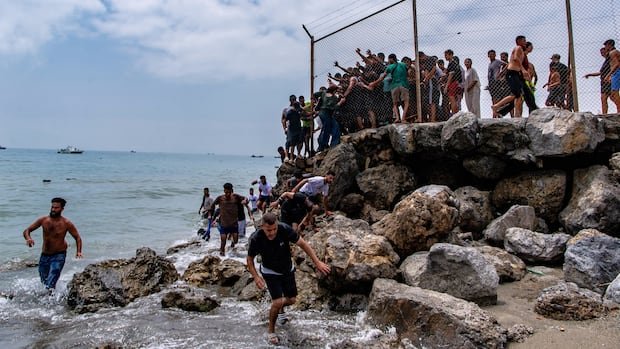
Authorities have labeled the situation as “complete disorder,” “unsustainable,” and “a breach.” Over 57 individuals have lost their lives following the infiltration of tens of thousands of migrants into Spain’s Ceuta enclave from Morocco by both land and sea, stirring astonishment and discord in Europe.
Approximately 60,000 individuals crossed into the Spanish enclave in North Africa on Thursday. By Friday evening, an estimated 48,300 had returned to Morocco, with many arriving by sea, either swimming the five kilometers from the Moroccan town of Fnideq or attempting to cross from the nearby town of Belyounech, which is a shorter distance.
Accounts from some swimmers, including one in a wetsuit who spoke to France 24, highlighted the challenges they faced during the journey. Concerns were raised about the presence of children and unaccompanied minors among those who crossed, prompting a Moroccan NGO to caution against endangering children’s lives on irregular migration trips.
Spanish authorities reported the recovery of 57 bodies on the Spanish side of the border, with potential additional casualties on the Moroccan side. Causes of death included drowning and injuries sustained while climbing the breakwater supporting the border fence.
Ceuta and the adjacent Spanish territory of Melilla, situated on the northern Mediterranean coast of Africa, serve as the EU’s sole land borders with Africa. These autonomous cities, although belonging to Spain, are not officially recognized by Morocco, which often refers to them as occupied territories.
Spain is a prominent gateway into Europe for migrants seeking improved economic prospects or refuge from violence in their home countries. Ceuta and Melilla, being heavily fortified, are frequently targeted by migrants aiming to reach Spain from Morocco and other African regions. Those who manage to reach these territories may face deportation or undergo asylum application processes in Spain.
The recent surge in migrant crossings into Ceuta has raised questions about the underlying causes. While specific triggers for the rush remain unclear, Spanish authorities linked it to a recent ruling by the Spanish Supreme Court regarding the deportation of sea arrivals versus land or fence climbers. Prime Minister Pedro Sánchez attributed the surge to human traffickers exploiting legal interpretations, although some activists argued that migrants might have been unaware of the legal nuances.
In response to the crisis, Spain deployed its armed forces and additional police to restore order in Ceuta. Moroccan security forces also took action to prevent further border breaches, with confrontations reported in Melilla as well. The situation prompted many migrants to attempt to return to Morocco due to lack of resources and shelter in Ceuta.
The sudden influx of migrants into Ceuta underscores long-standing issues in Morocco, including discontent with public services and high youth unemployment rates, pushing many to seek opportunities through irregular border crossings. Calm seas and potential political motives further complicate the situation, indicating broader power dynamics at play in the Mediterranean region.

