
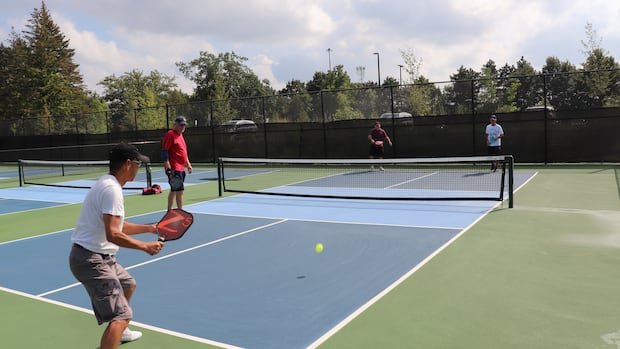


Across the nation, there’s a heated battle for court time between tennis and pickleball enthusiasts.
For instance, in Scarborough, Ontario, the conversion of two public tennis courts into six pickleball courts sparked controversy, leading to a petition from a tennis player urging the city to reconsider the decision.
A dispute between pickleball and tennis players on Mayne Island, British Columbia, even reached the Supreme Court of B.C., underscoring the broader challenge of limited public recreational facilities, according to Matti Siemiatycki, a University of Toronto geography and planning professor.
Siemiatycki highlights the scarcity of recreational spaces for various sports, emphasizing the need for a solution to address the inadequate supply.
Rather than letting sports communities vie for access to public facilities or relying solely on for-profit entities, experts suggest tackling the supply issue.
According to Peter Donnelly, a retired University of Toronto professor emeritus, developers should be mandated to construct more recreational amenities than current regulations stipulate, drawing parallels to past public housing strategies that incorporated parks and community spaces.
Developers’ dominance in this aspect needs to be addressed, reflecting the urgency to prioritize community well-being in urban planning.

Can pickleball help save Quebec churches?
March
