
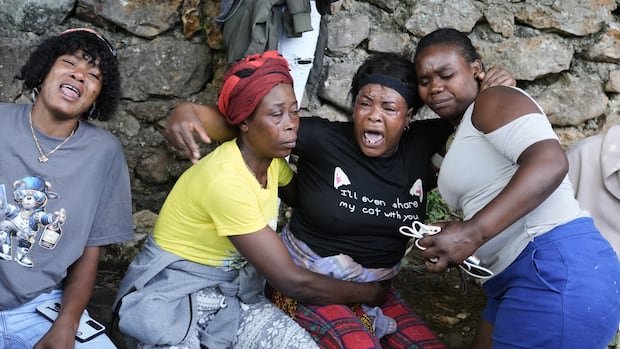
At least 47 individuals lost their lives, and 22 others sustained injuries in an assault by a gang overnight in a neighborhood overlooking the Haitian capital, Port-au-Prince, as confirmed by the United Nations on Monday. This incident has sparked outrage due to the perceived lack of security measures against recurring fatal attacks.
The United Nations Integrated Office in Haiti mentioned that the casualty figures are subject to change. Kenscoff’s mayor, Jean Massillon, reported that armed assailants launched an attack on the community late on Sunday, destroying homes and taking lives.
This hillside community, which overlooks the capital’s access routes, has experienced around twelve violent incidents orchestrated by armed groups since the previous year, compelling thousands to abandon their residences.
Despite efforts by foreign entities to bolster the country’s under-equipped police force, potent gangs, united under a broad coalition, have solidified their dominance over Port-au-Prince for years and extended their influence to neighboring areas.
Following what the government of Haiti condemned as a “barbaric assault,” pledges were made to enhance security measures. However, residents expressed their dissatisfaction by demanding the resignation of the local police chief, accusing the officers of failing to safeguard individuals who were killed just moments away from the police station.
In a social media post, the prime minister’s office emphasized, “Kenscoff will not be forsaken. The government’s control will be reestablished promptly and resolutely.”
Witnesses in Kenscoff described a scene of despair as they discovered the bodies of acquaintances and family members strewn across the streets early Monday morning. Survivors were overwhelmed with grief, with one woman repeatedly lamenting the loss of her son, while others tried to console her.
The aftermath of the attack left residents in anguish, with one man collapsing on the roadside in tears, and others solemnly carrying the deceased, some covered in blood-stained sheets. Robert Jean recounted the chaotic moments when gunfire erupted before dawn, recounting his frantic search for his brother, who tragically did not survive.
Blaming the government for the tragedy, a Kenscoff local, Verti Enold-Saint, expressed that effective policing measures could have prevented the violence, highlighting the need for better security arrangements.
Massillon attributed the assault to members of Viv Ansanm, a group designated as a foreign terrorist organization by the U.S. government last year. He condemned their actions, stating, “They sowed chaos.”
Gangs, particularly Viv Ansanm, control an estimated 70% of Port-au-Prince, with Kenscoff being a frequent target of their aggression. The spate of gang-related violence has displaced a record number of 1.5 million Haitians, with over 3,100 fatalities and 1,189 injuries reported between January and June this year, according to UN data.
The recent attack coincided with the deportation of over 160 individuals back to Haiti by the U.S. government, following a legal dispute that terminated temporary protected status (TPS) for around 350,000 Haitians. Among the deportees were individuals with criminal backgrounds, including gang members involved in offenses ranging from assault to drug trafficking.
As Haiti prepares for its first general elections in more than ten years scheduled for December 13, concerns have been raised about the perilous security situation, casting doubts on the feasibility of conducting the elections.

