
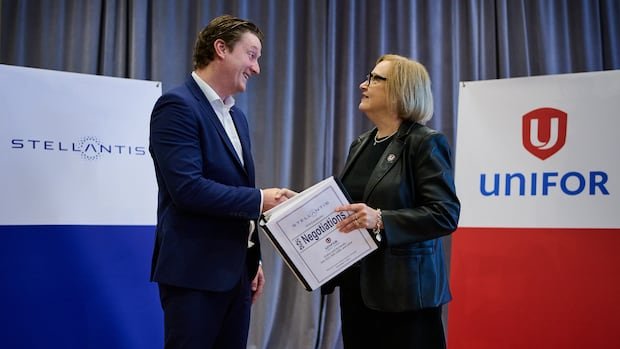
The labor union representing employees at Stellantis issued a caution to the American automaker regarding the treatment of Canadian workers as contract discussions commenced between Unifor and the company on Tuesday. These negotiations signify the final phase of Unifor’s talks with the Detroit Three automakers, employing a pattern bargaining strategy to establish terms for potential replication with other firms.
Despite successfully finalizing fresh collective agreements with Ford Motor Co. and General Motors in Canada earlier this year, Unifor’s national president Lana Payne emphasized that the greatest obstacle lies ahead. She acknowledged the challenges faced amidst uncertainties, tariffs, and trade disruptions, anticipating the ongoing negotiations to be exceptionally tough.
The negotiation deadline for reaching a new agreement is set for September 11. Job security, particularly following the layoff of over 2,000 workers at Stellantis’ Brampton assembly plant, remains the primary concern for the union. The plant has been inactive since 2023, with discussions of closure and sale surfacing last month.
Stellantis had originally planned to retool the Brampton facility for Jeep production, a process initiated in early 2024 but halted in early 2025. Subsequently, the decision to relocate Jeep Compass production to the U.S. was deemed a violation of the existing collective agreement by Unifor, resulting in indefinite idling of the plant.
In response to these developments, Payne stressed the importance of rectifying the situation and reinstating vehicle production at the Brampton plant. Stellantis acknowledged the significance of the ongoing labor discussions for its future, acknowledging the industry’s evolving trade and regulatory landscape.
As negotiations progress, the imposition of U.S. tariffs on non-domestic vehicles continues to add pressure to the talks. Payne highlighted the critical need for Canada to maintain its auto sector presence amidst the challenging economic conditions, emphasizing the potential adverse impact of escalating tariffs.
Larry Savage, a labor studies expert, noted the dual challenges facing Unifor in both bargaining with Stellantis and advocating against trade agreements that could jeopardize the Canadian auto industry. The recent ratification of contracts with General Motors by Unifor members reflects a positive outcome, with wage increases and three-year agreements mirroring those with Ford.
The current labor negotiations are pivotal not just for Stellantis but for the broader auto industry in Canada, emphasizing the need for a sustainable agreement that addresses the sector’s challenges effectively.

