
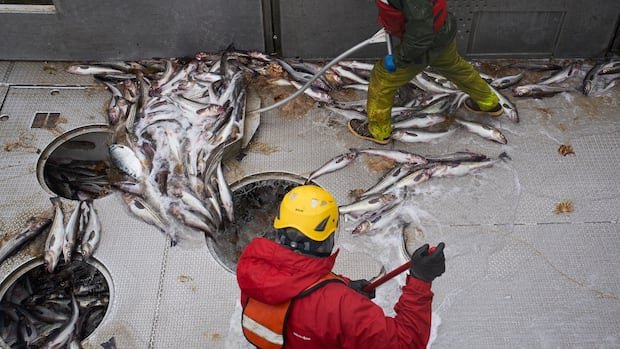
A dense net emerged from the turbulent waters of the Bering Sea, overflowing with Alaska pollock so tightly packed that their heads protruded through the mesh. Along with the catch, other marine creatures like a skate, crabs, jellyfish, and notably, salmon, spilled onto the deck, igniting a heated debate over industrial trawling practices in Alaska.
Maverick Blake, the captain of the boat, acknowledged the challenge of unintentionally catching non-target species in the wild capture fishery. Despite concerns, he emphasized the necessity of such practices to provide seafood for consumption. Blake altered the boat’s course to avoid salmon-rich areas, aiming to minimize bycatch.
Alaska pollock ranks as the world’s second-largest fishery, featuring prominently in U.S. McDonald’s Filet-O-Fish sandwiches, fish sticks, and imitation crab meat. While the fishery and McDonald’s emphasize environmentally conscious methods, the nets used for pollock also catch other marine life.
Bycatch, comprising marine species inadvertently caught during targeted fishing activities, accounts for two percent of the total pollock catch. In a fishery extracting billions of pounds of pollock annually, this translates to significant numbers of salmon, including Chinook and chum, caught as bycatch in Bering Sea trawlers over the past decade.
The declining salmon runs in western Alaska, affecting numerous Indigenous communities reliant on salmon for sustenance, have sparked widespread discontent. This backlash extends to smaller commercial and charter fishing operations feeling the repercussions of diminishing fish stocks. Trawling practices and bycatch have become focal points in Alaska’s political landscape, with gubernatorial and U.S. Senate candidates debating industry regulations.
In 2024, Alaska and Canada implemented a seven-year Chinook fishing ban along the Yukon River to aid in populations’ recovery. Scientists attribute the salmon decline to warming waters and changing ocean conditions rather than trawl bycatch. However, critics argue that bycatch represents a controllable factor in mitigating fish mortality, crucial for communities along the Yukon River.
Onboard the F/V Progress, Captain Blake and crew members strive to minimize salmon catch. Despite catching around 210 chum salmon during the observation period, Blake emphasized the importance of avoiding salmon to fulfill his duties. The vessel’s operations involve strategic navigation to avoid salmon-rich zones, involving significant fuel consumption in the process.
While the Bering Sea pollock fishery is extensively monitored to reduce bycatch, concerns persist among various stakeholders, including commercial fishers and charter operators facing diminishing catches due to bycatch from trawl fisheries. The habitat damage caused by trawling practices is another significant area of concern, as seen in the impact on seafloor ecosystems.
The opposition to trawling extends beyond fisheries meetings, garnering support from diverse groups like Democrats, Republicans, commercial and sport fishers, and Alaska Native communities. Political candidates have taken stances against trawling and bycatch, reflecting a growing consensus for stricter regulations in the industry.
As the debate over trawling continues, Captain Blake continues fishing for pollock in the Bering Sea, while the Woods family in Yukon remains restrained by fishing restrictions. While Blake envisions passing down his fishing legacy to his son, Brooke Woods hopes her son will have the opportunity to engage in traditional salmon fishing practices, echoing concerns about preserving cultural heritage amid changing fishing dynamics.

