
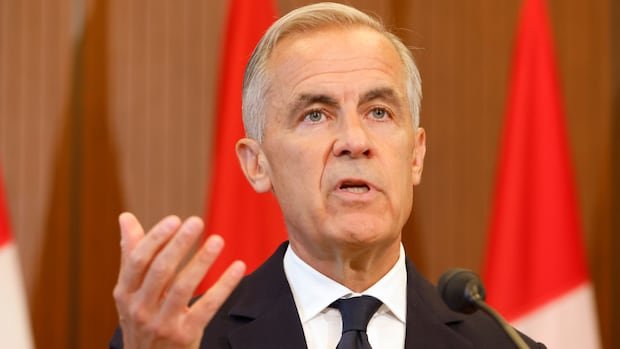
The Conservative Party is urging the government led by Prime Minister Mark Carney to disclose all the specifics of the proposed trade agreement between Canada and the United States that were under discussion before the talks collapsed recently.
Conservative Member of Parliament Shuvaloy Majumdar, who serves as the party’s shadow minister for Canada-U.S. relations, conveyed in a letter to Canada-U.S. Trade Minister Dominic LeBlanc on Sunday that the Conservatives are not seeking confidential negotiation details. Instead, they are interested in obtaining information that is already known to Ottawa and Washington. Majumdar emphasized that this information would enable Canadians to engage in debates and discussions regarding the future direction of the country.
Following the breakdown of prolonged trade negotiations between the two nations, the United States imposed a 50% tariff on approximately $28 billion worth of Canadian goods early on Saturday.
Prime Minister Mark Carney stated on Saturday that Canadian negotiators chose to walk away from the discussions after the United States presented what he deemed as unacceptable demands, including attempts to limit Canada’s ability to engage in other trade agreements. Carney emphasized that his government was unwilling to compromise Canada’s sovereignty or jeopardize key industries, announcing the implementation of “dollar-for-dollar” tariffs on U.S. goods starting on September 8.
U.S. Trade Representative Jamieson Greer attributed the failure of the talks to “new demands and reversals of prior commitments by Canada.” Greer outlined that the U.S. proposal included measures such as supply chain coordination in aerospace, actions to address unfair trade practices, cooperation on critical minerals, enhanced enforcement against imports produced with forced labor, and the initiation of formal negotiations under the U.S.-Mexico-Canada Agreement.
Moreover, Greer informed the New York Times in an interview on Saturday that the U.S. administration, led by President Donald Trump, had offered to reduce tariffs on softwood lumber by 10% and lower steel tariffs from 50% to 25%.
Despite the absence of the exact details of the negotiated deal being disclosed by either government, Prime Minister Carney’s decision to withdraw from the talks has received widespread support in Canada, including from provincial leaders like Ontario Premier Doug Ford and B.C. Premier David Eby. Many have endorsed Carney’s plan to impose retaliatory tariffs on the U.S. in the coming month.
David Coletto, founder and CEO of the Abacus Data polling firm, highlighted the concerns among Canadians about the escalating trade conflict and its potential impact on the economy and daily lives. However, he also noted a prevailing sentiment that Canadians are resolved not to be intimidated by Donald Trump, expressing support for the prime minister’s stance and awaiting the next steps.
Opposition party leaders have echoed the call for unity in response to Trump’s tariffs. Conservative Party Leader Pierre Poilievre emphasized the need to reject one-sided tariffs that could harm Canadian industries and advocated for pursuing tariff-free trade. Poilievre expressed his intention to confer with Carney to strategize on defending workers, businesses, and the economy.
Carney indicated that he would likely brief opposition leaders on the trade developments on Monday afternoon or Tuesday morning, responding to queries from reporters on Saturday.

