
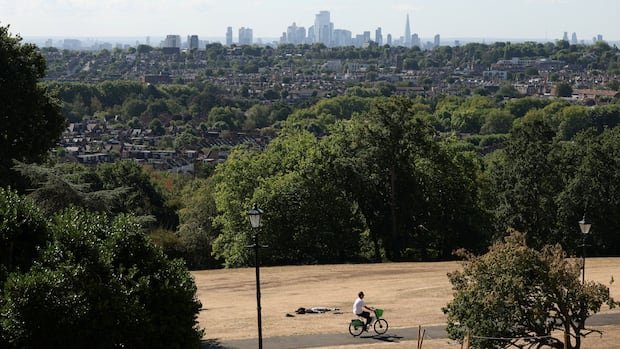
In the midst of a heat wave and severe drought in Britain this summer, Divya Hariramani was trimming a plum tree in south London when she noticed an issue with one of its branches. The branch was starting to detach from the tree due to the stress caused by the extreme heat, according to the workers at Mitcham Community Orchard.
Hariramani, who showcases fruit trees and their caretakers throughout the city on a social media platform named Fruity Walks, explained that the trees struggle to supply sufficient water to their parts during such conditions, leading to parts dropping off.
While London is renowned for its historic stone architecture, it also boasts a vast urban forest, considered the largest globally, at over 2,000 years old. However, this year has presented challenges for the city’s lush canopy, with five consecutive heat waves and a significant lack of rainfall straining plants and wildlife.
A recent report from Royal Botanic Gardens Kew predicts a grim future for London’s urban forest. By the end of the century, around 73% of the city’s trees could face the risk of dying due to the impacts of climate change.
The findings from Kew Gardens revealed that a substantial percentage of public trees in London are not well-suited to the expected climate conditions by 2090 without emission reduction measures. Additionally, a notable portion of these trees is considered vulnerable.
The effects of climate change are already visible, with 400 trees at Kew Gardens dying in 2022 due to extreme heat and drought. This led to the symbolic display of a red oak tree skeleton to depict the impact of climate change on London’s tree population.
As London faces increasingly warmer temperatures, experts are considering planting different tree species that can better adapt to the changing climate. Botanical horticulturists at Kew Gardens are exploring tree varieties that can thrive in hotter, drier weather conditions while enduring the region’s wet winters.
Paul Wood, a writer specializing in London’s tree heritage, is concerned about the future of the city’s green spaces amidst record heat and drought. He emphasizes the historical and ecological significance of London’s ancient trees and the biodiversity they sustain, underscoring their irreplaceable value.

