
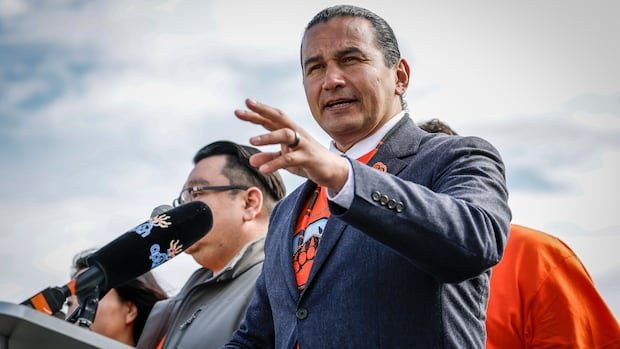

Manitoba Premier Wab Kinew expressed his stance on the issue of residential school denialism, emphasizing that while he finds it reprehensible, he believes it should not be made illegal. Kinew disagreed with NDP Member of Parliament Leah Gazan’s proposal to criminalize this behavior, asserting the importance of educating the public and dispelling misinformation instead.
Gazan initially introduced Bill C-254, a private member’s bill aimed at amending the Criminal Code to address hatred towards Indigenous communities, in October 2024. Despite the bill’s initial failure due to the 2025 election, Gazan remains committed to its reintroduction, emphasizing the need to combat the denial or justification of the residential school system.
The proposed legislation seeks to prohibit any public endorsement, denial, justification, or trivialization of the Indian residential school system in Canada, extending beyond private conversations. Gazan argued that protecting survivors and their families from hateful ideologies is crucial for genuine reconciliation efforts.
Throughout a span of more than 150 years, starting in the 1830s until 1997, Indigenous children from First Nations, Inuit, and Métis communities were forcibly removed and placed in residential schools, often located far from their homes. These government-funded institutions, predominantly operated by Christian religious organizations, aimed to assimilate Indigenous youth into mainstream Canadian culture.
An estimated 150,000 children attended these schools across Canada, with over 4,000 documented deaths reported by the National Centre for Truth and Reconciliation. Recognizing the historical significance of these institutions, Kinew announced a collaborative effort with the City of Brandon to acquire a former residential school property to preserve its memory and honor the victims.
Sioux Valley Dakota Nation, the current landowners of the school site, is actively involved in decisions regarding the former cemetery on the property, working alongside academic researchers to identify and commemorate the children buried there. Rev. Stan McKay, reflecting on his family’s experiences with the residential school system, emphasized the importance of acknowledging and reconciling with this dark chapter in Canadian history.
Both Kinew and McKay highlighted the significance of incorporating comprehensive education about residential schools in Manitoba’s curriculum, ensuring that future generations learn from this painful past. They emphasized the need for ongoing awareness and commemoration efforts to prevent the erasure of this tragic history and its enduring impact on Indigenous communities.
Kinew stressed the importance of educating not just students but also adults in various settings, such as workplaces, churches, and community gatherings, to uphold the memory of residential schools and prevent the recurrence of past injustices.
Efforts to address residential school denialism and promote truth and reconciliation continue to be at the forefront of discussions surrounding Indigenous rights and historical injustices in Canada.
