
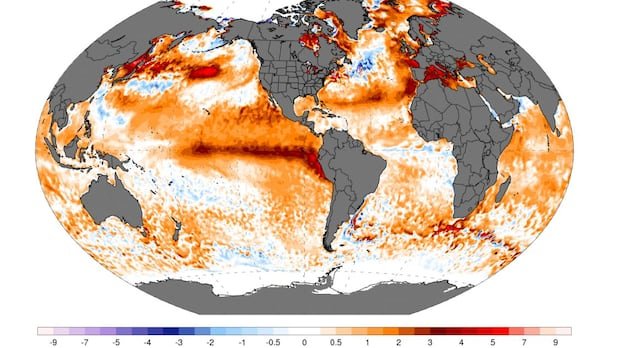
The highly anticipated El Niño has arrived, and it’s already proving to be as impactful as predicted. Earlier this year, climate experts had predicted the development of an El Niño in the central Pacific region. As time went on, more models indicated the likelihood of a strong or “super” El Niño, although uncertainties remained.
In June, the U.S. National Oceanic and Atmospheric Administration (NOAA) confirmed the presence of warmer conditions in the specific Niño 3.4 region of the Pacific Ocean in its monthly update. To be classified as an El Niño, temperatures in this area must be at least 0.5°C above average. Currently, ocean temperatures are nearly 2°C higher than average, setting a record for this time of year.
Climate scientist Zeke Hausfather mentioned that the region is already experiencing temperatures over 2°C, indicating the potential for a very strong or even “super” El Niño. The peak of this El Niño is expected around October, with some models suggesting a later peak in November or December.
El Niño and La Niña are part of the El Niño Southern Oscillation (ENSO) cycle, affecting the Pacific Ocean region. El Niño brings warmer temperatures, while La Niña brings cooler conditions. The transition from La Niña to El Niño has been notably rapid this year, according to meteorologist Nat Johnson.
Experts are considering the possibility of this extreme El Niño being influenced by climate change, although scientific consensus on this matter is still pending. Concerns about the impact of this El Niño on food security in tropical regions and the increased risk of wildfires in Canada have been raised.
Overall, the effects of El Niño are significant and should not be underestimated, affecting various sectors from agriculture to ecosystems. The ongoing developments in the Pacific Ocean region continue to be monitored closely.

