
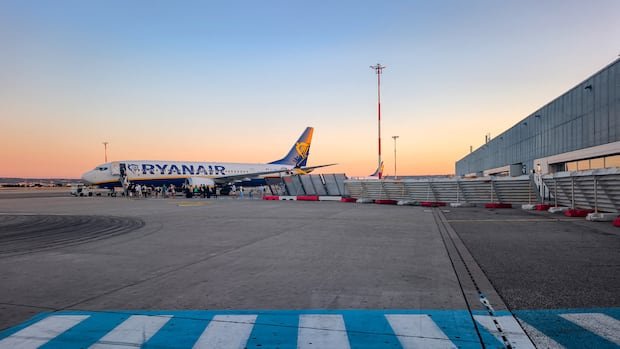
A Ryanair aircraft experienced a window shattering incident after departing from Greece last month due to broken engine parts, with a man’s head nearly being sucked out through the opening before being saved by fellow passengers, according to U.S. investigators. The incident involved a fan blade detaching from the right engine of the Boeing 737-800, leading to fragments damaging the window and fuselage. The U.S. National Transportation Safety Board (NTSB) received the responsibility for investigating the event under international aviation regulations.
The occurrence took place on July 10 following the departure of the flight from Thessaloniki, Greece. Investigators discovered bird remains in the engine, hinting at potential bird strikes during takeoff, although the exact cause of the fan blade detachment remains undetermined. The 61-year-old passenger involved suffered neck and shoulder injuries along with friction burns.
Flight attendants reported hearing loud vibrations and observing smoke or fog in the cabin, prompting the release of emergency oxygen masks. Passengers assisted in pulling back the man lodged in the damaged window, moving him to another row for medical attention. Videos from inside the plane displayed passengers using oxygen masks after a pressure drop, with first responders attending to the situation post-landing.
Maintenance records indicated that the failed fan blades underwent inspections in May 2026 and November 2025 without any identified damage. However, the NTSB noted four previous suspected bird strikes on the same engine, with bird remnants found after two incidents. While the necessary maintenance seemed to have been carried out as scheduled, investigators plan to scrutinize the inspection methodologies and potential contributions of prior bird strikes to the damage.
Ryanair refrained from further comments until the NTSB concludes its investigation, with Boeing and CFM International collaborating in the inquiry. The FAA had issued directives in April 2025 mandating enhancements to engine coverings on Boeing 737s to prevent further incidents like previous fan blade failures. Although airlines were given until July 2028 to make the required modifications, the NTSB report highlighted the pending changes on the Ryanair plane.
The recent event might prompt reassessment of the deadline for modifications by the FAA and NTSB, considering the potential impact on industry safety practices. The FAA refrained from commenting on the ongoing investigation, emphasizing its cooperation with the NTSB for necessary safety measures. The involved 737-800 aircraft, operated by Malta Air, a Ryanair subsidiary, was delivered in 2008 and can accommodate up to 189 passengers. Flight data showed a brief altitude climb followed by a descent to burn fuel before the aircraft safely returned to Thessaloniki after the incident.

