
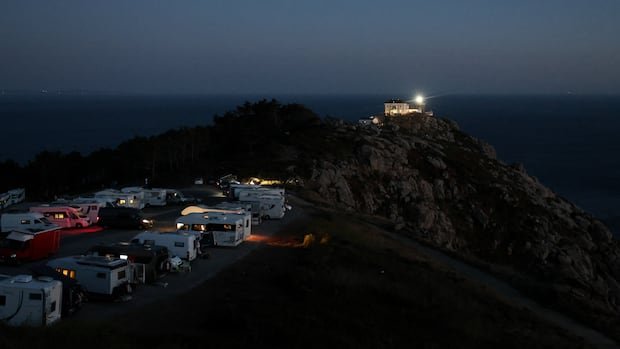
Hundreds of thousands of visitors have flocked to Spain to witness the solar eclipse happening on Wednesday. However, the event coincides with soaring temperatures and an escalated risk of wildfires in Spain, causing concern for authorities keen on preventing any long-lasting fire damage from the surge in astrotourism.
Virginia Barcones, the secretary general for civil protection and emergencies at Spain’s Interior Ministry, emphasized the need to curb activities that could trigger fires due to the challenging summer marked by significant forest fires. The ongoing heatwave across Europe, coupled with a severe wildfire season in Spain, has already consumed over 603,000 acres of land in approximately 400 fires this year, as reported by the European Forest Fire Information System.
To avert any potential rise in fire incidents, authorities are mobilizing 35,000 officers on Wednesday to monitor large outdoor gatherings in a bid to detect and prevent any new fires. Spain stands out as one of the prime locations for viewing the solar eclipse, with the path of totality spanning around 200 kilometers across several countries, including northern Russia, eastern Greenland, western Iceland, and parts of Spain.
Only individuals within the path of totality will witness the complete coverage of the sun by the moon. While a partial eclipse will be visible in Canada, cautionary advice from authorities emphasizes the use of eclipse glasses for eye protection. The anticipation surrounding this solar eclipse, the first visible from mainland Spain in 120 years, has triggered a surge in travel interest.
Special provisions endorsed by the Ministry of the Interior have been put in place to manage the expected influx of visitors for the solar eclipse. The spike in accommodation searches along the eclipse’s path signals a significant increase in interest, particularly in Valencia, Spain, with a 245% surge compared to the previous year.
Regional governments have identified 660 official viewing sites to accommodate over 440,000 anticipated spectators. Authorities estimate that approximately 1.5 million people could be on the move to reach these viewing locations. Concerns about fire risks have prompted both national and local authorities to caution against activities like barbecuing and venturing into dry rural areas.
The economic impact study by the Ministry of Economy, Trade, and Business projects that the eclipse will contribute over 347 million euros to Spain’s economy. Despite the prevailing dry conditions and wildfire fears, the enthusiasm among eclipse enthusiasts remains unwavering, with travelers eagerly awaiting the celestial spectacle.
As the eclipse day approaches, the forest fire index is expected to reach high to extreme levels across the Iberian Peninsula and the Balearic Islands. With the country experiencing alarmingly low rainfall, the risk of wildfires remains a top concern, especially since a significant portion of wildfires is attributed to human activities.
AEMET, Spain’s meteorological agency, forecasts temperatures exceeding 35°C on the day of the eclipse, with some regions expected to hit 40°C. Although temperatures are projected to decrease slightly during the eclipse, the risk of wildfires looms large. The eclipse’s path will bring totality to different regions at varying times, with Spain witnessing totality closer to sunset.
Despite the challenges posed by the heatwave and wildfire threats, eclipse travelers remain undeterred, driven by the allure of experiencing nature’s grand spectacle. The shared experience of witnessing the eclipse is expected to resonate with tourists, fostering a deeper appreciation for the environment and climate change impacts.
The upcoming trio of solar eclipses, including the 2026 event, holds promise for increased astrotourism in Spain. With the next solar eclipses scheduled for 2027 and 2028, the potential for more celestial tourism opportunities is on the horizon, further enhancing Spain’s appeal as a prime location for witnessing these extraordinary cosmic events.

