
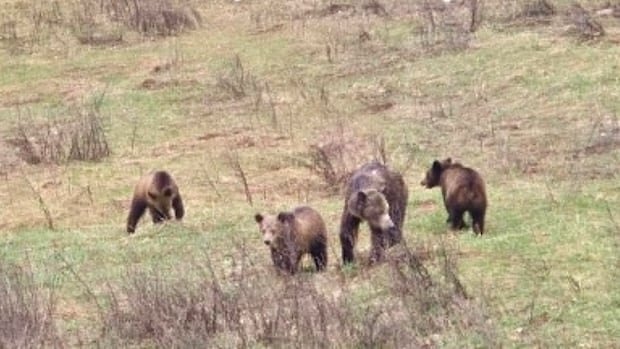
In a recent announcement, the B.C. Conservation Officer Service confirmed the euthanasia of a mother grizzly due to concerns over its food-conditioned behavior and loss of fear towards humans. The two remaining yearlings were relocated to an undisclosed location for ongoing monitoring.
A demonstration was held in Nelson, B.C., to denounce the decision by the B.C. Conservation Officer Service to put down a young grizzly bear. This bear was part of a group of grizzlies frequently spotted in and around Nelson.
Katie Graves, the founder of the Ursa Project Society, described the emotional gathering at the rally, expressing that the euthanized yearling grizzly, which had a leg injury or deformity, should not have been killed. She emphasized its mobility, ability to keep up with its family, and feeding capabilities.
According to the B.C. Conservation Officer Service, the decision to euthanize the bear was based on factors such as its age, injury, and past conflicts, which deemed it unsuitable for rehabilitation or relocation. The service acknowledged the difficulty of such decisions and emphasized the humane treatment of affected animals.
Graves mentioned that the mother bear had previously been relocated after bringing cubs to the area in 2023 but returned shortly afterward. The status of the other grizzlies, including a sow and two yearlings, remains undisclosed, with the Conservation Service assessing each captured bear individually.
The incident has generated significant community discussion, with many criticizing the decision to euthanize the grizzly. Some community members highlighted the importance of securing garbage properly to prevent bear encounters.
Wildlife biologist Clayton Lamb stressed the need for stricter policies to reduce attractants and prevent bear-human conflicts. He emphasized the challenges of rehabilitating habituated bears, noting the importance of discouraging bears from entering urban areas.
The City of Nelson outlined its efforts to mitigate conflicts and promote coexistence with wildlife, including implementing bear-resistant garbage cans and educational programs. Bylaw services are actively enforcing regulations on waste management and wildlife attractants to minimize human-bear interactions.

