
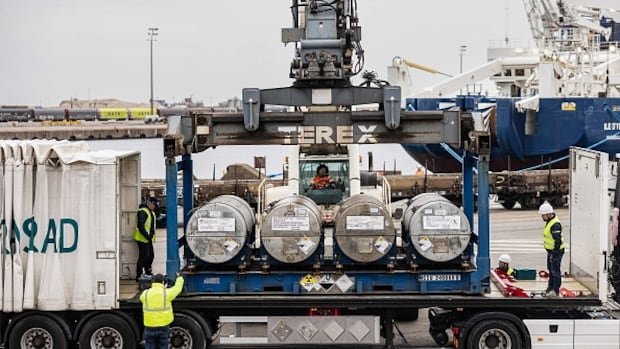
In the midst of Russian President Vladimir Putin’s military occupation of Ukraine’s largest nuclear plant and ongoing attacks on the country’s power infrastructure, Europe and the United States continue to rely on Russian nuclear fuel to sustain their electricity networks.
One of the recipients of low enriched uranium (LEU) from Russia for commercial nuclear reactors in the U.S. is Canadian-owned Westinghouse Electric, as revealed by shipping data analyzed by CBC’s investigative program, the fifth estate.
Although the U.S. officially prohibited the import of Russian enriched uranium in August 2024 to reduce dependence on Russian materials and ensure a robust domestic fuel supply, the Prohibiting Russian Uranium Imports Act allows for waivers under specific circumstances until January 1, 2028.
According to a report by the Bellona Environmental Transparency Center in Vilnius, Lithuania, the U.S. imported approximately 400 tonnes of low enriched uranium from Russia in 2025, valued at around $1 billion US. Notable recipients included subsidiaries of French-owned nuclear company Framatome, U.S. nuclear fuel supplier Global Nuclear Fuel Americas, and Westinghouse.
While the European Union has not imposed a ban on the importation of Russian enriched uranium, Canada has refrained from sanctioning business dealings with Russia’s Rosatom or Tenex in light of the conflict in Ukraine. Calls have been made to reduce dependence on Russian nuclear supplies by all nations.
Westinghouse’s fuel fabrication plant in South Carolina receives uranium from Russia, where it is processed into fuel pellets for commercial nuclear power reactors. The company, partially owned by Brookfield Renewable Partners and Cameco Corporation, plays a significant role in the U.S. nuclear industry.
Efforts are underway to lessen the long-standing reliance on Russian enriched uranium in the U.S. and Europe by boosting domestic production. However, replacing Russian supplies remains challenging due to the significant role Russia plays in global uranium enrichment.
In response to the situation, Canada and its allies are urged to avoid engagement with Russian state nuclear entities to prevent further support to Moscow’s actions. Initiatives have been taken to support Ukraine by transitioning to alternative fuel sources and building new reactors with non-Russian involvement.

