


Thoroughbreds snort as they toss their heads, while eager hooves beat an erratic rhythm into the freshly raked sand on a warm August afternoon.
The loudspeaker crackles to life with the announcer’s booming voice, prompting spectators to approach the track, some leaning against or even climbing atop the white rail fence.
Excitement fills the grandstands at Onion Lake Cree Nation’s Heritage Park, located 50 kilometers north of Lloydminster on the Saskatchewan side of the border, as the fifth and final day of the event known as Indian Relay Racing is about to commence.
“The crowd has been fantastic; the stands have been full every day,” said race organizer Candy Jackson. “With four relays happening simultaneously, 14 incredible and humble teams chose to compete at Onion Lake, which I truly appreciate.”
This team sport features riders racing laps around a track while switching horses. Each rider completes three laps bareback, riding a different horse for each lap. The transitions are intense, requiring riders to dismount and place both feet on the ground before mounting the next horse.
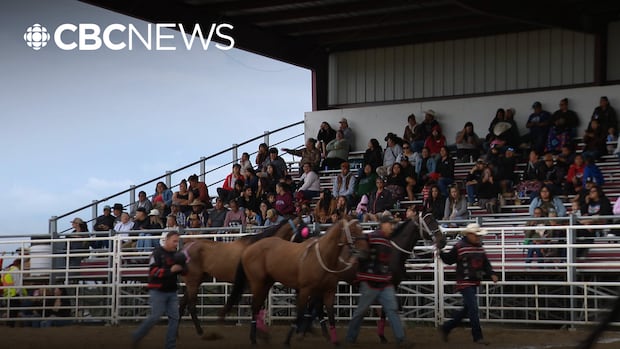
This sport involves racing down a dirt track on the bare back of a thoroughbred and is gaining popularity nationwide. As Lexi Freehill reports from Onion Lake Cree Nation, it represents much more than just fast horses and thrilling exchanges; it embodies a cultural connection.
Collisions among riders, overly enthusiastic or stubborn horses, and falls can swiftly alter the outcome of a race.
Over the past ten years, the sport has been gaining traction across the Prairies, with races becoming a staple of summer events and attracting large audiences alongside increasing cash prizes.
Tyson Head, a farrier from Mistawasis, Sask., has been involved in horse racing for his entire life. Since founding his team T.K. Farrier in 2017, he has witnessed a surge in dedicated fans and six-figure payouts becoming commonplace.
“We’ve been competing for nine years and have secured numerous championships and titles,” he shared with CBC News.
Head noted that the increasing interest in the races is drawing in more sponsors, which in turn encourages more potential participants to get involved in the sport.
“When I first got started, there were just 16 teams,” he recalled. “Now, there are over 40 teams actively participating.”
This growth paves the way for further expansion, according to Head. Newcomers learn from established teams and eventually create their own, welcoming more aspiring racers and sharing valuable knowledge and expertise in horsemanship.
A backholder for T.K. Farrier shifts his weight as he prepares to catch the reins of the fast-moving horse while rider Carter Houle prepares for the third and final exchange in the championship race. (Lexi Freehill/CBC)
However, while the surge in the sport brings numerous advantages, Jackson, who is from Goodfish Lake, mentioned that the increase in popularity can also lead to challenges.
“Initially, we started with wahkohtowin, which signifies unity and family,” Jackson explained. “We used to help each other, ensuring everyone made it to the events, especially if someone faced difficulties.”
“As the years progressed and events grew larger, that sense of unity diminished, and people became more focused on winning championships.”
Jackson aims to ensure that the races and the riders remain connected to their cultural roots, both as an organizer and as the mother of Kal “Buffalo Boy” Jackson, one of the first Canadian relay riders.
Starting her race events with a pipe ceremony and prayers helps to ground the sport in its traditions. Additionally, some riders, like 19-year-old cousins Kyla and Kayden Stanley, engage in prayers and smudging for themselves and their horses before racing.
19-year-old jockey Kayden Stanley, from Onion Lake Cree Nation, aspires to demonstrate his skills at the Calgary Stampede in the future. (Lexi Freehill/CBC)
“[It] brings me a sense of calm and safety while out there,” Kyla Stanley told CBC News.
“This sport can be quite dangerous if you’re reckless,” Kayden Stanley stated. “But if you run safely, it’s a truly rewarding experience.”
More significant than the monetary rewards and championship titles is the chance for each rider to honor tradition and remember their heritage, according to Jackson, who emphasized that many young jockeys have overcome personal hardships.
“The true essence of the sport is that the riders possess a talent; the gift is derived from the horse,” she stated. “It embodies the healing spirit of the animals.
“The spirit of the horse has brought them back to this place, making them true warriors.”
