
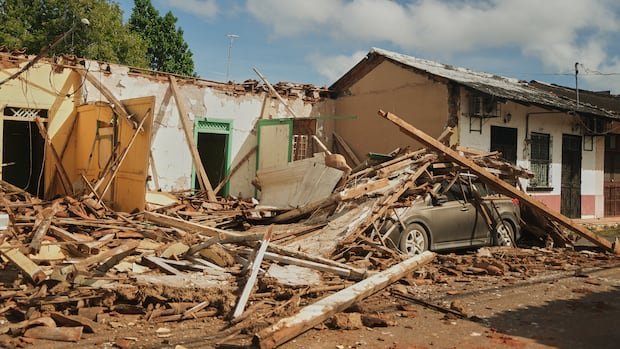
Panama’s government has declared a state of emergency following two powerful earthquakes that struck the country, causing extensive damage but no reported deaths. The earthquakes, measuring 7.7 and 6.6 magnitudes, led to building collapses near the epicenter and forced evacuations across Panama. More than 100 aftershocks were recorded, with magnitudes including 5.8, 5.5, and 5.2.
The initial earthquake, which was felt in neighboring Colombia, originated approximately 10 kilometers southwest of Pitaloza Arriba in Herrera province. The earthquakes damaged homes, schools, healthcare facilities, roads, and hotels in all of Panama’s provinces and two Indigenous territories.
The emergency declaration was announced by Presidential Minister Juan Carlos Orillac in Panama City. The National Civil Protection System reported 27 people with injuries, ranging from minor to moderate. Most of the damage was concentrated in the central provinces of Veraguas, Herrera, Cocle, and Los Santos, with approximately 420 homes and an equal number of public schools affected.
In La Villa de Los Santos, a historic Catholic church and several homes collapsed. The scene of destruction prompted residents to seek guidance from the government. Despite the widespread damage, Panama’s strict building codes likely contributed to the relatively low toll compared to recent earthquakes in neighboring countries.
Rising sea levels prompted evacuations on Isla Cana, and road damage left some communities cut off. The earthquakes caused disruptions to water treatment plants, hospital operations, and air travel, including the temporary closure of Tocumen International Airport.
International assistance and messages of support poured in, with the U.S. government pledging $5 million for humanitarian aid and dispatching helicopters with food supplies to affected communities in Panama. The Panama Canal Authority confirmed that operations along the vital trade route were unaffected by the seismic events.
Panama’s location along the “Ring of Fire” makes it prone to earthquakes due to tectonic plate interactions. The country’s resilience to seismic events will be tested as recovery efforts and assistance from neighboring nations continue.

