
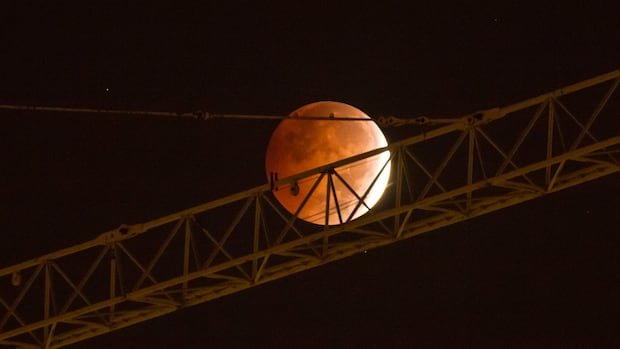
On the night of August 27-28, a deep partial lunar eclipse will be visible nationwide, following a recent total solar eclipse over Iceland, Spain, and parts of Portugal. Lunar eclipses occur when the moon traverses Earth’s shadow, starting with the outer penumbra and then the darker umbra. Most of Canada will witness the eclipse in its entirety, with Western Canada catching the partial eclipse as the moon rises.
Unlike solar eclipses, a lunar eclipse does not require protective eyewear and unfolds over several hours. The eclipse will commence as the moon enters Earth’s penumbra around 10 p.m. ET, with the visible phase starting at 10:33 p.m. ET on August 27 and concluding at 1:52 a.m. on August 28. The peak of the eclipse, darkening most of the moon, will occur at 12:13 a.m.
Notably, this event is part of a series of astronomical occurrences this month, as highlighted by Elaina Hyde, director of the Allan I. Carswell Observatory at York University. While it won’t be a total “blood moon,” certain regions in Canada may witness a reddish hue during the eclipse. Lunar eclipses are easily observable with the naked eye, though binoculars or a smartphone with a good night mode can enhance the viewing experience and capture quality images.

