
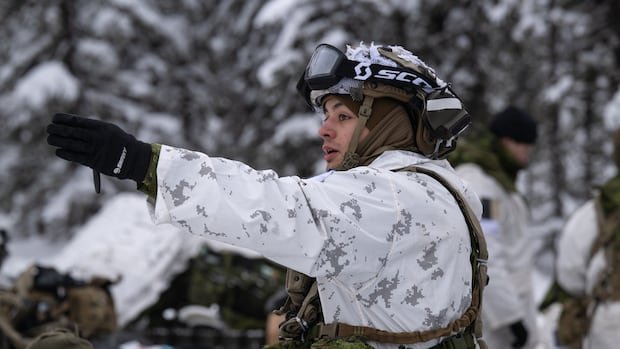
A set of internal documents from the Department of National Defence suggests that Canadian troops were not adequately prepared and sometimes lacked the necessary equipment to face challenging conditions during a significant training exercise with U.S. forces in Alaska last winter. The assessment reports, acquired by CBC News, indicate that the military has a significant amount to improve upon in order to enhance its ability to safeguard the Arctic region.
The exercise involved more than 400 members of the 3rd Battalion Royal Canadian Regiment (3RCR), who were integrated into a larger U.S. Army brigade during Exercise Global Response in February at the Joint Pacific Multinational Readiness Center, situated north of Fairbanks, Alaska. The Canadian government has committed to maintaining a nearly year-round presence in the Far North. The reports highlight that troops will need to focus less on technology and more on fundamental skills to effectively engage and survive in Arctic combat situations, as per defense experts.
Distinct evaluations conducted by both Canadian and American authorities highlighted numerous concerns that cast doubt on the preparedness of troops and their equipment to operate in severe conditions, including temperatures dropping below -30°C. The Canadian evaluation criticized a recent initiative that allowed the regiment to acquire civilian equipment off-the-shelf to supplement military cold-weather gear, which led to operational issues.
In an interview, Lt.-Col. Aaron Corey, the commander of 3RCR, disputed the criticisms, stating that his troops underwent a year-long training regimen for winter conditions before the Alaska deployment. He emphasized that all soldiers participating in the exercise were qualified as cold weather operators, with leaders receiving specialized cold weather training. Corey mentioned the battalion’s extensive preparations leading up to the exercise to re-establish proficiency in winter and Arctic warfare.
Despite facing challenges, including numerous frostbite cases, the battalion successfully achieved its training objectives during the exercise. Corey highlighted the valuable lessons learned by the troops, emphasizing the need to adapt to the weather conditions, which often posed a greater threat than the enemy. The reports also touched on issues such as gaps in medical team understanding and equipment limitations due to extreme cold.
The separate American evaluation noted similar difficulties faced by U.S. units, underscoring basic preparation issues like inadequate snow-clearing equipment and fuel shortages to prevent engine freezing. Experts, including retired colonel Pierre Leblanc and Arctic defense specialist Rob Huebert, emphasized the necessity for a return to fundamental skills and a mindset shift to operate effectively in the challenging Arctic environment.
In conclusion, while acknowledging recent efforts to enhance winter exercises through increased defense spending, experts stress the importance of relearning essential skills for operating in the Arctic effectively. Huebert cautioned against underestimating the complexities of Arctic warfare, emphasizing the need for a comprehensive and practical approach to defense strategies in the region.

