
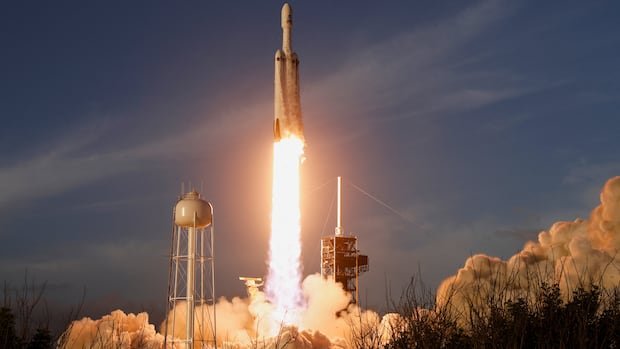
NASA has initiated a groundbreaking mission to explore key mysteries in astrophysics and cosmology by launching the Nancy Grace Roman Space Telescope, a refurbished spy satellite turned astronomical observatory. The telescope, valued at around $4 billion, was transported to orbit beyond the moon via a SpaceX Falcon Heavy rocket from NASA’s Kennedy Space Center in Cape Canaveral, Florida. It is set for a five-year mission duration with the potential for an additional five years based on fuel availability.
Designed to delve into cosmic puzzles like dark energy, dark matter, gravity on vast scales, and the search for exoplanets, the Roman telescope will be stationed at Lagrange Point 2, approximately 1.6 million kilometers away from Earth. Named after NASA’s first chief astronomer, known as the “mother of the Hubble Space Telescope,” the telescope will undergo a 90-day commissioning phase before commencing scientific operations. It is anticipated to transmit its initial high-resolution images before the upcoming winter holidays.
NASA officials are optimistic about the impact of the Roman telescope, emphasizing its ability to complement existing observatories such as the James Webb Space Telescope and the Hubble Space Telescope. NASA Administrator Jared Isaacman expressed confidence that the Roman telescope will become a household name, akin to its renowned counterparts.
In contrast to the deep-space probing capabilities of the Webb telescope, Roman offers a wide-angle view of the cosmos. This feature allows it to capture panoramic views swiftly, enabling it to survey the Milky Way galaxy within a month, a task that would take the Hubble telescope a century to accomplish. By mapping over two billion galaxies, Roman aims to enhance the understanding of dark energy and dark matter, constituting the majority of the universe’s contents.
The universe comprises ordinary matter, dark matter, and dark energy, with dark energy believed to drive the universe’s accelerating expansion post the Big Bang event. By studying the gravitational effects of dark matter and the expansive force of dark energy across the universe, scientists anticipate making breakthroughs in these enigmatic phenomena. Additionally, Roman is poised to conduct an extensive search for exoplanets, potentially uncovering thousands of new planets and providing valuable insights into planetary systems similar to our own.

