
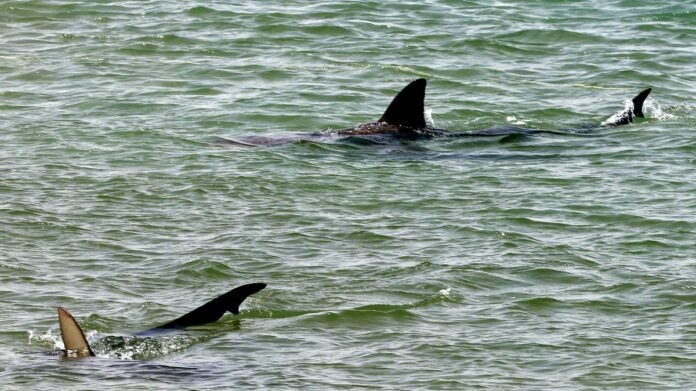
A man aged 40 has passed away following an attack by a type of shark previously considered harmless. The victim, a tourist, was swimming and recording footage approximately 100m from the shoreline in Hadera, near Israel, when he was surrounded by dusky sharks.
Eyewitnesses reported that a shark made a sudden move towards the man’s GoPro camera, after which he was heard shouting for help as he was being bitten. Subsequently, the man disappeared from view as the water turned red, with shark fins visible on the water’s surface.
Unfortunately, when rescue boats reached the scene, the man had already vanished, as per local reports. Subsequent searches at sea led to the retrieval of human remains in minimal quantities, confirming the victim’s identity and indicating that he had been consumed by multiple sharks during the incident, as detailed in a report published in the journal Ethology.
While dusky sharks can grow up to about 3m (10ft) long, they are typically shy and cautious around humans. Experts suggest that the rare dusky shark attack was likely influenced by various factors, including animal instincts during feeding frenzies, warm water discharge from desalination plants along the coast, and the abundance of food waste in the area.
Additionally, human interactions, such as feeding the dusky sharks and fish scraps being thrown into the water by local boat operators to attract the sharks for tourists, have led to the development of a new behavioral pattern known as “begging” among the sharks. This has resulted in sharks associating humans with food, causing them to exhibit aggressive feeding behaviors, especially in the competitive food environment off the coast of Hadera.
Experts emphasize the importance of taking measures to prevent future dusky shark fatalities, suggesting that a complete ban on public artificial feeding of sharks is essential to eliminate begging behavior among the sharks. They assert that other measures may be complementary but are less impactful compared to this primary approach.

