
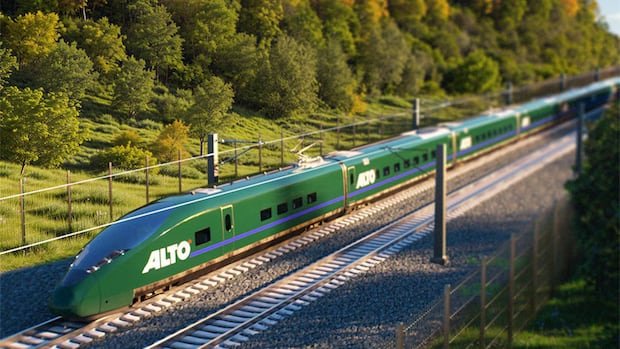
Alto Affirms Commitment to High-Speed Rail Project Amid Opposition from Quebec Government
The Crown corporation overseeing a proposed high-speed rail link between Toronto and Quebec City remains steadfast in its determination to bring the project to fruition, despite resistance from the newly elected Parti Québécois (PQ) administration.
Throughout the electoral campaign, the PQ pledged to disengage from Alto’s envisioned railway endeavor should they assume power. PQ Leader Paul St-Pierre Plamondon contends that the funds allocated for the project should be redirected to uphold the province’s deteriorating infrastructure, including hospitals, roads, and public transportation.
A recent report by the Parliamentary Budget Office indicates that the construction cost for the proposed high-speed rail initiative could range from $75 billion to $113 billion, surpassing the initial estimates. St-Pierre Plamondon argues that if there are billions of dollars available for infrastructure investments, constructing the high-speed rail link is not a top priority for Quebec residents.
In response to the PQ’s opposition, Alto held a public meeting where they affirmed that the project’s lifespan, from conception to completion, is projected to span approximately 15 years, involving collaboration with multiple governments. The aim is to commence construction by 2029.
J. Robert S. Prichard, the chair of Alto’s board of directors, emphasized that their focus is on meticulous preparation and timely delivery within the stipulated budget and mandate expectations, leaving government relations to the relevant authorities.
Regarding the PQ’s stance on the project, the federal transport minister’s office underscored the Canadian government’s commitment to cooperative federalism and willingness to collaborate with the Quebec government on this venture.
Expressing optimism about the project’s long-term benefits for Quebecers, the minister’s office highlighted its potential to revolutionize intercity travel between Quebec and Ontario, enhancing opportunities for work, education, and social interactions.
However, according to André Lecours, a professor at the University of Ottawa’s political studies department, the project’s feasibility hinges on securing the Quebec government’s support. Lecours opined that proceeding without the PQ’s approval is unlikely, as maintaining a harmonious relationship with the Quebec government is paramount for the federal government.
The Conservative Party of Quebec, which secured a historic 19 seats in the recent general election, has also voiced opposition to the high-speed rail initiative.
Jérémie Letellier, president of the Fédération de l’UPA de la Montérégie, raised concerns about the detrimental impact of the rail line on agricultural communities in Ontario and Quebec, emphasizing the need for adequate compensation for affected farmers.
Alto sought to allay farmers’ apprehensions during the public meeting, assuring that the railway network would not disrupt numbered highways or major transportation routes. Detailed plans for the initial segment linking Ottawa and Montreal are anticipated in the fall, with construction slated to commence in 2029.

