
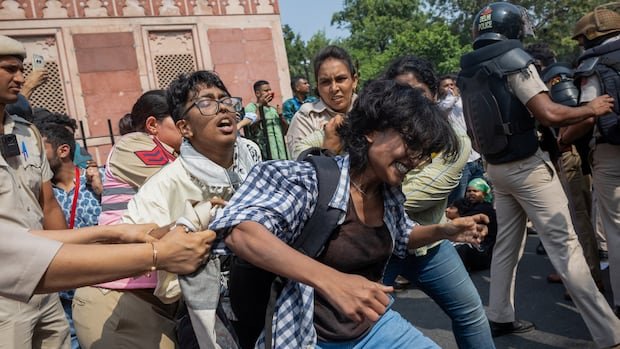
Indian authorities implemented a widespread security crackdown in New Delhi and detained numerous protesters on Saturday as India’s youth movement, known as the “Cockroach” movement, escalated a nationwide campaign against a controversial voter list revision. This revision has sparked discontent towards Prime Minister Narendra Modi’s Hindu nationalist government and election authorities.
Police took action to disperse the protest before it could start, intercepting demonstrators en route to Jantar Mantar, the designated protest site in the heart of the capital. Some protesters were chased off, while many others were detained, with some being forcefully taken away and transported to temporary detention facilities. Key leaders of the Cockroach Janta Party (CJP), as well as opposition lawmakers and student activists, were apprehended before the protest could gain momentum.
The security measures extended beyond the protest area, with police setting up checkpoints on routes into the capital, screening buses, cars, and other vehicles for demonstrators. Jantar Mantar was cordoned off, and anti-riot vehicles equipped with tear gas launchers were stationed along critical routes. Additionally, restrictions on mobile internet access and parts of the city were imposed, adding to the challenges faced by protesters.
Authorities had refused permission for the protest, citing a late submission of the request. A spokesperson for Modi’s party, Sambit Patra, disparaged the demonstrators as “anarchic elements,” declaring their demonstration a failure.
The heightened crackdown highlighted the authorities’ resolve to disrupt a growing protest movement that has rallied thousands of young individuals, garnered opposition backing, and intensified scrutiny of Modi’s leadership. These protests come at a sensitive political juncture, following previous demonstrations by the movement that led to the resignation of Modi’s education minister in July over exam paper leaks.
Security was tightened around the protest site, with movement leaders Abhijeet Dipke, Saurav Das, and Ashutosh Ranka being detained upon their arrival in Delhi. The movement condemned the preemptive police action as an attempt to stifle the peaceful demonstrations before their commencement.
Despite the stringent security measures, some protesters managed to breach police barricades, chanting slogans against Modi and election authorities before being apprehended. The police response marked a significant display of force in the capital, raising concerns about the space for public dissent in the democratic nation.
The demonstrations revolve around the Election Commission’s Special Intensive Revision, criticized by the opposition for disenfranchising millions of eligible voters. Protesters demand the resignation of Gyanesh Kumar, the chief election commissioner, and the cessation of the revision, which has resulted in the removal of over 130 million names from voter lists. The Election Commission and the government refute allegations of voter manipulation, asserting that the revision aims to eliminate duplicate and ineligible entries.
Opposition parties have seized on the voter list dispute as a rallying point to challenge Modi’s Bharatiya Janata Party. The demonstrations coincide with increased opposition activities in the capital, with Congress party leader Rahul Gandhi briefly detained by police.
The CJP movement views the voter list controversy as an opportunity to expand its advocacy efforts. Originating online in May, the movement gained traction through protests and hunger strikes relating to alleged exam paper leaks, leading to the education minister’s resignation in July. For Modi, the protests present a mid-term challenge in his third term, with their political ramifications yet to fully unfold.
While national elections are not scheduled until 2029, next year’s state elections in Uttar Pradesh and Gujarat will serve as crucial tests for the BJP’s electoral standing.

