
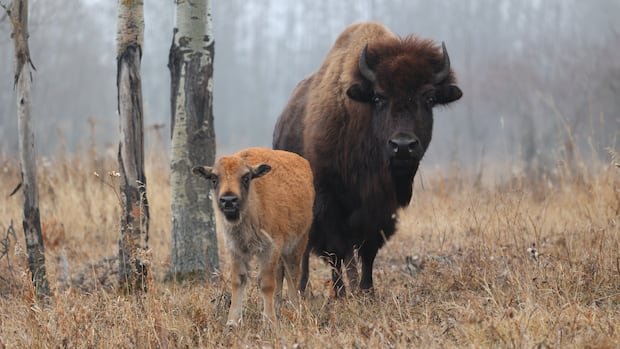
Bison, once abundant across North America, were nearly wiped out by human activities, leading to significant changes in their genetic makeup and population dynamics.
A recent study, detailed in the journal Science, analyzed the DNA of 160 bison genomes, providing insights into the species’ history over the past 20,000 years.
Led by paleogeneticist Jonas Oppenheimer and the Paleogenomics Lab at the University of California, Santa Cruz, the research involved the collaboration of nearly 40 scientists, many of whom were Canadian.
The study aims to inform conservation efforts by understanding the genetic diversity and historical changes in bison populations, which are now fragmented and managed in isolated herds.
According to Oppenheimer, historical genetic homogeneity among bison has given way to distinct genetic variations in present-day herds due to past human-driven population bottlenecks.
Genetic Insights
Researchers utilized ancient bison bones and DNA from existing herds to track the evolution of genetic diversity in bison populations. The study included samples from managed herds in Canada and the United States, as well as wild herds in various locations.
The genetic analysis involved sequencing 115 ancient bison genomes and 45 modern genomes, contributing to the most extensive genetic mapping of bison to date.
Chris Jass of the Royal Alberta Museum highlighted the importance of using ancient DNA to inform modern conservation practices and emphasized the collaborative nature of the study.
The study also shed light on the impact of historical events, such as intensive hunting in the late 19th century, on the genetic diversity and structure of bison populations.
Diverse Bison Species
Contrary to common beliefs, the study revealed that most bison have minimal cattle ancestry, with wood bison and plains bison showing significant genetic distinctions.
Wood bison, adapted to northern habitats, and plains bison, suited for open grasslands, diverged around 3,000 years ago due to environmental changes. Human interventions further influenced genetic mixing between the subspecies.
Greg Wilson of Parks Canada emphasized the importance of managing distinct bison populations separately, despite some intermixing in the past, to preserve genetic diversity and species integrity.
‘Conservation Strategies’
Collaborative efforts, like the Bison Integrated Genomics project, are crucial for preserving bison populations through genetic conservation and management strategies.
Researchers suggest implementing measures to reconnect isolated herds to prevent genetic loss and inbreeding, ensuring the long-term survival of bison populations.
Ancient genomes serve as valuable references for maintaining genetic diversity and facilitating the return of bison to their natural habitats, promoting species resilience and diversity.
For more information, you can visit the source.

