
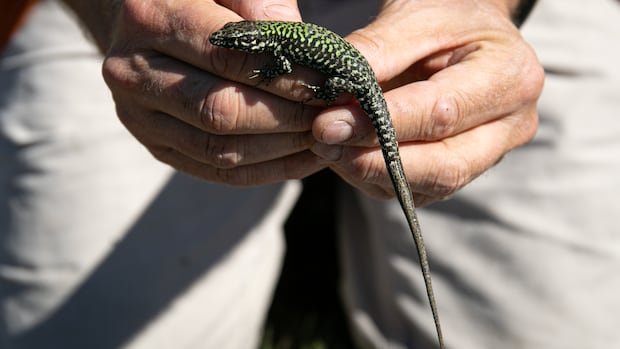
Tracy Menzies had been battling slugs in her backyard garden for a while, but this year, she triumphed as her strawberries flourished beautifully. The reason behind the decline of slugs in her garden seems to be the increasing presence of the invasive European wall lizard. These lizards are rapidly spreading across the area, devouring various creatures from insects to slugs.
Living near the Gorge Waterway in Saanich, Menzies observed a surge in the number of wall lizards roaming her garden recently. She suspects that these lizards are feasting on the slugs, leading to a noticeable decrease in the slug population on her property.
Gavin Hanke, the curator of vertebrate zoology at the Royal B.C. Museum, estimates that there are around 800,000 to a million European wall lizards in British Columbia, predominantly on Vancouver Island. The lizards have even reached Campbell River, which is 220 kilometers north of Victoria, raising concerns about their environmental impact. Hanke emphasized the need to adapt to coexisting with these lizards, as eradicating them is no longer feasible.
The spread of these lizards has been concerning biologists like Nicholas Wong from the Invasive Species Council of B.C., who highlighted the competition they pose to native lizard species for resources and habitat. The initial release of 12 lizards in 1970 from a closed roadside zoo in Central Saanich led to the current population explosion in B.C., with the lizards finding the island’s climate favorable for their survival.
The European wall lizards, being omnivores, consume a variety of insects, spiders, invertebrates, and fruits, impacting the local ecosystem. While they might have aided Menzies in safeguarding her strawberries, the unchecked spread of these lizards poses challenges for residents like her.
The key to managing the spread of European wall lizards lies in collective efforts within communities, as isolated removal attempts may prove ineffective. Hanke emphasized the importance of creating unwelcoming habitats for the lizards to limit their presence. Reflecting on human-induced environmental disruptions, Hanke underscored the need for responsible actions to mitigate further ecological imbalances caused by invasive species like the European wall lizards.

