
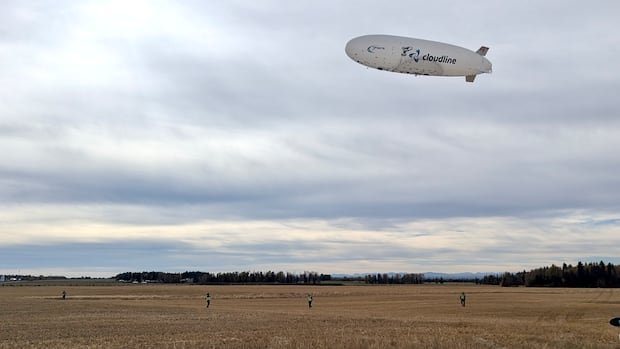
In central Alberta last week, a unique 20-meter airship caught the attention of onlookers, sparking curiosity about the rare sight. While the sight of a blimp may be familiar at sporting events, spotting a solar-powered airship, similar in size to a school bus, in rural Alberta is indeed uncommon.
The airship, developed by South African firm Cloudline and Canadian partner 3 Points in Space Media, conducted flight tests near Rocky Mountain House, around 200 kilometers southwest of Edmonton. Operating as a remotely piloted aircraft system with automated flight controls, the airship was designed for collecting aerial survey data in remote areas such as monitoring pipelines and infrastructure.
The technology behind the airship represents a modern take on traditional airship technology, combining autonomous control systems with the airship itself. This innovation allows for the airship to carry heavier camera and LiDAR sensors over longer distances compared to standard drones.
Despite the advancements, crewed aircraft are still preferred in extreme weather conditions due to their resilience. However, the research initiative led by TC Energy aims to utilize the airship for gathering various types of data efficiently and quietly, compared to conventional aircraft.
3 Points in Space Media’s Vice President of Research and Development, Michael Adams, sees the airship as a promising opportunity to revive historic aviation technology that faded after the 1930s. He shared his excitement for modernizing airship technology and bridging the gap between past achievements and present innovations.
Residents of Rocky Mountain House were intrigued by the airship, with Mayor Shane Boniface expressing amazement at the rare sighting. The airship’s visit led to a social media buzz, surpassing the attention garnered by a recent tornado in the area.
While Cloudline operates airships globally, including in countries like South Africa, Namibia, and Kenya, the presence of autonomous airships in Canadian airspace remains limited. The next phase for the flight team involves cold-weather testing in Northern Ontario to ensure the airship can operate efficiently in sub-zero temperatures and Arctic conditions.

