
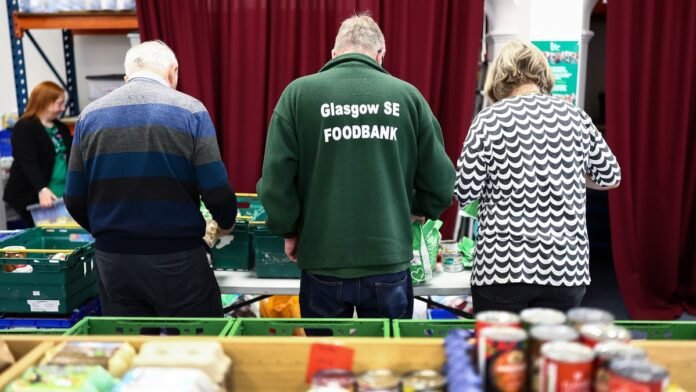
The Joseph Rowntree Foundation has reported that a record number of individuals in the UK are facing “very deep poverty.” According to the foundation, poverty levels have worsened, with those affected now living 29% below the poverty threshold, compared to 23% in the mid-1990s. The report highlights that 6.8 million people are experiencing “very deep poverty,” nearly half of those living in poverty, marking the highest level on record.
Despite the positive impact of Labour’s decision to remove the two-child benefit cap, leading to a reduction of around 400,000 children in poverty compared to the previous year, the JRF has cautioned that without additional measures, relative poverty rates are expected to remain high post-April this year. The report also reveals a concerning trend of increasing child poverty, with numbers reaching 4.5 million children and rising for the third consecutive year.
The issue of hunger is also escalating rapidly, with an additional 1.1 million impoverished individuals struggling to afford sufficient food compared to two years ago, bringing the total to 3.5 million. The BBC is reportedly considering utilizing iPlayer streaming data to identify individuals who have not paid for a TV license. Currently priced at £174.50 annually, a TV license is mandatory for watching or recording live TV programs on any channel, as well as for viewing content on BBC iPlayer, whether live or on catch-up.
Furthermore, significant changes are expected in the self-assessment tax system starting April 2026 with the implementation of Making Tax Digital (MTD). Sole traders and landlords with an annual income exceeding £50,000 will be required to adopt the new tax reporting system, involving an average initial cost of £320 for MTD-compatible software and subsequently, £110 annually. The MTD rollout will gradually include lower income thresholds, with the threshold set to decrease to £30,000 by April 2027 and further to £20,000 by April 2028.
Moreover, the UK is facing challenges in the energy sector as wholesale gas prices, including those in Europe, have surged due to freezing weather conditions in the United States. The disruption in gas exports, especially liquefied natural gas, has led to increased prices, with the UK’s day-ahead price reaching 104.13p per therm. The impact of these price hikes on household energy bills remains uncertain, though the prolonged high wholesale prices are expected to exert upward pressure.
Lastly, the Centre for Cities has identified the UK towns and cities experiencing the fastest growth in disposable income. Highlighting an economic growth of 27% between 2013 and 2023, these regions have seen a 5.2% increase in living standards, outperforming the national average of 2.4%. Brighton emerges as the top performer with an 8.1% rise in living standards, followed by Worthing at 7.8% and London at 5.8%.

