
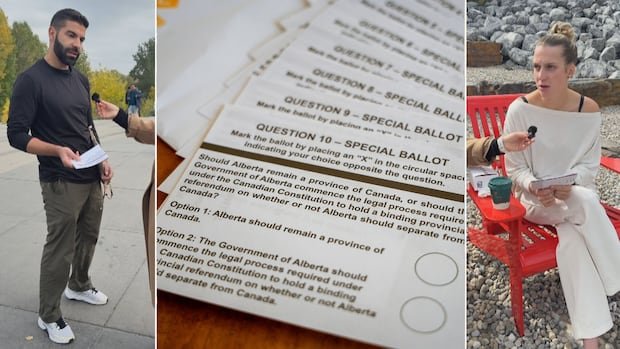
Carla Hudson Kam, head of the linguistics department at the University of British Columbia, finds the Alberta referendum questions to be notably intricate upon reading them. She points out the elaborate sentence structures and the numerous verbs and clauses within the questions as challenges. Hudson Kam, who holds a PhD, emphasizes that the questions exceed the average reading level of most Albertans, requiring careful consideration to grasp their full meaning.
The length and complexity of the 10 questions contribute to the difficulty faced by voters. The longest question on the ballot, the eighth one, asks if voters support Alberta opting out of federal programs to fund its own initiatives. The official question is detailed and involves amending the Canadian Constitution to allow provinces to opt out of federal programs affecting provincial jurisdictions without losing associated federal funding.
The readability of the questions is further highlighted by the Flesch-Kincaid test, which measures the difficulty of understanding English text. Analyzing Question 8 with an online calculator revealed a “college graduate” reading level, indicating a high level of complexity. Despite being shorter, the separation question received a similar score.
Recent observations suggest that some individuals attending election information events feel overwhelmed and confused by the referendum questions. Polling data indicates that nearly half of the surveyed individuals are unfamiliar with the non-separation questions. Elections Alberta emphasizes that they cannot interpret the questions and advises directing inquiries about the questions’ meanings to the government or an MLA.
In response to concerns about question complexity, the Alberta premier’s office referred to the online referendum website. Various organizations have been hosting information sessions across Alberta to help voters understand the questions better before casting their votes on October 19. Elections Alberta offers voting guides in multiple languages and allows the use of personal devices for translation assistance during voting. Additionally, individuals can bring a friend or family member to aid in understanding and marking the ballots.
Hudson Kam urges voters to familiarize themselves with the questions to avoid misinformation and make informed decisions independently. She emphasizes the importance of understanding the questions thoroughly to ensure voters are not swayed by biased interpretations.

